Showing posts with label St Jude. Show all posts

Monday, September 27, 2010

TCT: Weighing the risks and benefits of vascular closures

WASHINGTON, D.C.–Vascular closure devices can be successfully deployed and off-label devices not approved by the FDA can be used when they are evaluated on a patient-by-patient basis weighing the risks, benefits and cost, said D. Christopher Metzger, MD, of the Wellmont Holston Valley Medical Center in Kingsport, Tenn., during a presentation Sept. 24 at the 2010 Transcatheter Cardiovascular Therapeutics (TCT)  annual scientific meeting.
“The truth is, while we all try to use FDA-approved techniques and products, in the art of medicine, there come situations where there is no FDA approval out there to guide,” said Metzger. “In those cases, we have to individualize and use our clinical judgment and available evidence for the best interest of our patients.”
Often during peripheral artery intervention, a unique, alternative closure site is necessary when the usual route becomes blocked, Metzger said, “We often need popliteal artery access, radial access, large venous sheaths and the occasional puncture of the subclavian artery.”
With what Metzger called these “unique” accesses, he said that patients may benefit even more from closure devices due to the fact that often nurses are not familiar with pulling sheaths from these locations and the difficult nature of closure of some access sites, including the small popliteal artery.

Metzger explained that the antegrade popliteal artery or brachial arteries are harder to compress because of their smaller size. “If I open tiny arteries, I really don’t want you to sit there holding pressure for 15 to 20 minutes right after I finish it,” he said.
Metzger said that you must ensure that you are individualizing the risk/benefit ratio and costs prior to a procedure; use an angiogram to see whether or not you should use various devices; and individualize the closure devices to the particular patient artery.
Metzger offered that the Angio-Seal (St. Jude Medical) may not work best for smaller arteries like the brachial or popliteal arteries due to the size of the device left behind in the artery after closure. While he prefers using the Perclose ProGlide vascular closure system (Abbott Vascular), he said that you must be careful of the leading edge during peripheral work, particularly when maneuvering around a chronic total occlusion (CTO) or stent. He noted that the Perclose devices work best in the brachial arteries, popliteal arteries and sometimes even extravascular cases.
He also offered that the antegrade closure approaches are more complex compared with retrograde approaches because of the likelihood of puncturing the superficial femoral artery located in a higher position. However, Metzger noted that the Angio-Seal device may work best in these cases.
During popliteal artery access, Metzger said that a road-map approach is best  to puncture the artery in the right place. He and colleagues have used the procedure in almost 50 patient cases and have only had complications where a sheath needed replacement.
As for brachial access, he said that it is important to assess the artery and weigh the risks and benefit ratio of the procedure; however, he said that this procedure allows for the removal of larger sheaths while patients are fully anticoagulated, reducing the rates of thrombotic complications.
He noted that careful and accurate marking is most important when performing these closures so you ensure to not pinch a smaller artery closed and noted that the Perclose device may be best.
“Vascular closure devices can be used successfully in a large spectrum of  arterial and venous access sites off-label … the use of these devices has to be based on an individual assessment—the risks, benefits and costs, for each patient and their particular access site,” Metzger concluded.

Tuesday, September 21, 2010

St. Jude Says Data Reveals Excellent Sealing Performance Of Angio-Seal

(RTTNews) - Medical devices companySt. Jude Medical, Inc. (STJ: News ) Tuesday said subset data results for the Angio-Seal Evolution Vascular Closure Device Registry reaffirmed the excellent sealing performance of the Angio-Seal Evolution vascular closure device in patients undergoing routine diagnostic and interventional cardiac catheterization procedures.
The Angio-Seal Evolution device is designed to enable physicians to quickly and effectively seal femoral artery punctures made during minimally invasive catheter-based procedures.
The company noted that the results validated the exceptional performance of the device after being successfully deployed in 99.7% of procedures and with hemostasis achieved in 97.8% of these procedures by the device.
This new subset analysis strengthens those findings by demonstrating no significant difference in deployment success or hemostasis for patients with challenging conditions that might negatively impact device performance, such as obesity and scar tissue at the vascular access site, the company added.

Tuesday, August 24, 2010

Kensey Nash Q2 - Edited

Joseph Kaufmann
Our total revenue for the quarter of $21.9 million exceeded prior year by 7% and increased 10% sequentially. Total net sales of $15.1 million exceeded prior year by 12% and increased 14% sequentially. This growth was due to sports medicine, which increased 58% year-over-year and 9% sequentially; and our cardiology products, which are primarily Angio-Seal components, also increased 14% year-over-year and 3% sequentially.
As far as the Angio-Seal collagen sales, again, our third and fourth quarter collagen sales to St. Jude were very good. And we look at the comp compared to last year and our first quarter, it's primarily again due to timing. We expect our second quarter sales to St. Jude will reflect this and will show the improvement.........
It's products, it's quality, it's all that things that you think of every day, and that we think with hopefully some of the new products that we're brining to the marketplace, the biologic products, we believe are going to be a major factor in all of healthcare going forward. And Kensey Nash is going to be a major player in this space, not only in sports medicine, but also in general surgery and in other areas that we're very well positioned with the technology we have built here over the last five to 10 years or so within our organization....

Josh Jennings - Jefferies & Company

And then just last one just on the St. Jude supply agreement. Anymore color you could provide in terms of what happens? I know that's a tiered supply agreement for the component parts, but after 2011, it seems that that minimum 25% does that end in 2011 and you could renegotiate for 2012? And then lastly, is there any risk of the Angio-Seal royalty rate going away at some point?

Joseph Kaufmann

On the supply agreement, it's a two-year deal that starts at January 2011, so it goes out for '11 and '12. And then after that it will be determined whether it will be expanded, increased, decreased, or renewed, I don't know at this time.

As far as royalties are concerned, we are a royalty on Angio-Seal sales. As long as there is at least one claim on any patent, we're entitled to the full 6% royalty, there aren't any step-downs. So as long as there is patents in place that are being utilized, then that's when we continue to receive the royalty.


Monday, May 24, 2010

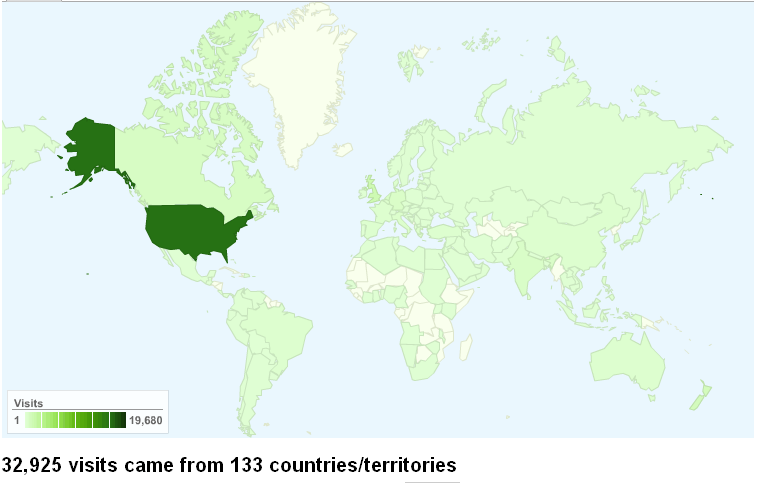
Hemostasis Blog Valued Resource!

The Medical Hemostat Blog has gained wide geographical and company interest. You are welcome to contact me at hemostatguy@gmail.com. I also have consulted with market research firms such as Frost and Sullivan amongst other research organisations.

While I address a need for comprehensive information regarding hemostasis, I am pleased to announce our top, google analytics identified company visitors:

  1. Johnson & Johnson
  2. CryoLife
  3. Baxter
  4. Trauma Cure
  5. Tyco
  6. Zymogenetics
  7. Medafor
  8. Hemcon
  9. King Pharmaceuticals
  10. Entegrion
  11. St. Jude
  12. Aventis Behring
I would appreciate any contributions readers care to send and am actively seeking projects in this field.
Thank You for following the Blog.
HG

FDA Issues St. Jude Warning Letter Over Epicor Surgical Ablation Device

A Warning Letter from the U.S. Food & Drug Administration (FDA) to St. Jude Medical Inc. has been posted on the agency’s web site. The letter alleges that St. Jude promoted the Epicor surgical ablation device to treat atrial fibrillation, a use that has not been approved by the agency.

Surgical ablation devices like the Epicor system are approved for “ablation,” or the burning of tissue, to seal a wound to stop bleeding. While doctors are permitted to use medical devices in any way they see fit, manufacturers are legally barred from marketing or promoting such uses. St. Jude has received the go-ahead from the FDA to investigate the Epicor system’s use in treating atrial fibrillation, but not approval to market it for this use.

In a Warning Letter dated April 23, the FDA cited marketing statements such as one on the St. Jude’s website last year that the Epicor system is “designed to safely, effectively and reproducibly create a classic box lesion in a single step.” According to The Wall Street Journal, the statement referred to a pattern of burns imprinted on the heart during atrial fibrillation surgery. The letter said statements like that violated the Federal Food, Drug and Cosmetic Act.

The letter also said the FDA found similar problems with marketing brochures and materials aimed at physicians.

Recently, St. Jude acknowledged an investigation by the U.S. Department of Justice into similar false marketing claims involving Epicor. In its most recent quarterly report, the firm stated that it had received a letter from the Department in October 2008.

In March, we reported that Medtronic Inc. and Boston Scientific Inc. had confirmed that the Department of Justice was investigating their marketing of the devices. Another firm, AtriCure, agreed to pay $3.8 million to resolve allegations it marketed its surgical ablation devices for the unapproved purpose of treating atrial fibrillation.

It is estimated the about 80 percent of atrial fibrillation patients are effectively treated with drugs. Unfortunately, there are few studies available that compare the safety of ablation to other types of atrial fibrillation treatments. Since 2008, there have been at least five U.S. patient deaths reported to an FDA data base in procedures using AtriCure devices and one involving a Medtronic device.

Thursday, April 22, 2010

St. Jude Medical Inc. Q1 2010

..........Total sales of cardiovascular products for the first quarter of 2010 were $256 million, up 7% over the first quarter of 2009, including $10 million of favorable foreign currency translation. On a constant currency basis, first quarter cardiovascular products sales increased 3% versus last year. Within this category of products, sales of vascular closure products in the first quarter of 2010 were $98 million consistent with the first quarter of 2009.........

Tuesday, September 22, 2009

St. Jude Medical to Showcase Complete Cardiovascular Access, Intervention and Hemostasis Management Solutions at Transcatheter Cardiovascular Therapeu

ST. PAUL, Minn.--(Business Wire)-- St. Jude Medical, Inc. (NYSE:STJ) today announced it will display products and technologies from the company`s portfolio of solutions for cardiovascular healthcare professionals at the 21st annual Transcatheter Cardiovascular Therapeutics meeting in San Francisco. The featured products reflect the company`s continued commitment to developing comprehensive, high-performance solutions which advance the practice of interventional cardiology by improving efficiencies and giving physicians more control. The company`s latest products and technologies for access, intervention, hemostasis management, cardiac rhythm management, and valve replacement will be demonstrated and on display on Sept. 23 and Sept. 24 from 9 a.m. to 5 p.m. and Sept. 25 from 9 a.m. to 2 p.m. at the St. Jude Medical booth (#1704) including:
Hemostasis Management:
From active vascular closure to compression-assist devices, St. Jude Medical has the most complete portfolio of products to aid physicians in achieving hemostasis following cardiovascular interventions. St. Jude Medical presents the eighth generation of the successful Angio-Seal product family with the most advanced design yet - the Angio-Seal Evolution. With the addition of two compression-assist devices following the acquisition of Radi Medical Systems, RadiStop Compression-Assist Device and FemoStop Gold Compression-Assist Device, the company can now offer physicians a full spectrum of closure technology to aid hemostasis. * Angio-Seal Evolution Vascular Closure Device: The new Angio-Seal Evolution device incorporates its repeatedly proven active closure system using a fully bioabsorbable anchor with a new, simpler system for deployment. This next-generation product from the industry-leading Angio-Seal product line was designed to reduce the number of necessary steps for closure and to assist physicians in overcoming procedural variables. The need to manually compact the collagen was eliminated, and only one suture cut is required. The Angio-Seal Evolution has received FDA and CE Mark approval. * Other Products on Display: Angio-Seal VIP, RadiStop Compression-Assist Device and FemoStop Gold Compression-Assist Device.

Thursday, April 23, 2009

Kensey Nash Corporation F3Q09 (Qtr End 3/31/09)

Total revenues for the quarter were $20.6 million, or comparable to the prior year and as I mentioned earlier inline with our guidance for the quarter. When we look at our net sales for the quarter, sales of biomaterial products were $12.9 million. This represents an increase of 3% year-over-year. Within this biomaterial segment, we have cardiovascular products, which are primarily Angio-Seal component sales. These sales increased 6% year-over-year and our spine medicine products increased 11% year-over-year...........
Angio-Seal royalties were $5.3 million or flat year-over-year. Again, this is due to the negative impact of foreign exchange. If you exclude the negative impact, the actual estimate of royalties would have increased by approximately 7% year-over-year. Again unit sales were up year-over-year and I think that's important to keep in mind in looking at the performance of the Angio-Seal and the performance of St. Jude with these products in the marketplace and the ongoing strength and of the product as it continues to dominate in this sector...........
From the Q & A

Spencer Nam – Summer Street Research

Thanks for taking my questions. Excuse me, just couple of quick questions. First of all, on the Angio-Seal, I was wondering if you could give us any color on the competitive dynamics right now with the Angio-Seal evolution out there? And how definitions are comparing Angio-Seal versus some of the passive closure devices? Are you seeing any change in the – how physicians are preferring one part of another recognizing that Angio-Seal does have the super majority of the market at this point?

Joseph Kaufmann

I can only give you my view of this world. I certainly can’t speak for St. Jude. And I really don’t have a lot of information on Evolution. As far as the – how that product is doing specifically in the marketplace. But I can tell you in terms of what we see or hear in the marketplace is that, with a product like Angio-Seal and the reason why it continues to do so well and continue to dominate the market is, because quite frankly it’s a very good product. It has great, great clinical data, great labeling, it’s easy to use. The passive devices and always has been our position at Kensey Nash is they don’t work. They are – they become relatively expensive band-aids as opposed to doing the job that closure devices are intended to do. So, that’s why we think we have been able to or St. Jude has been able to command such great market share in a continuing large market share. So, I’m sure there is always going to be other competition that comes into the market and we will, - we could do well for either a short period of time or may somewhere down the road come up with a better idea, but I haven’t seen it yet.

Source: Seeking Alpha

St Jude Q1 '09 - edited

Total sales of cardiovascular products for the first quarter of 2009 were $240 million, up 15% over the first quarter of 2008 including $12 million of unfavorable foreign currency translations. On a constant currency basis, first quarter cardiovascular product sales increased 21% versus last year. This product category includes sales of products that St. Jude Medical acquired from Radi Medical Systems in December 2008. Within this category of products sales of vascular closure products in the first quarter of 2009 were $98 million, up 9% over the first quarter of 2008. Sales of heart valve products in the first quarter of 2009 were $81 million, a 4% increase over the first quarter of 2008.

For the second quarter of 2009, we expect cardiovascular product sales to be in the range of $235 million to $250 million. We now expect full year 2009 cardiovascular product sales to be in the range of $955 million to $985 million. This 2009 outlook range is slightly less than the full year 2009 guidance range we provided last quarter which primarily reflects the stronger US dollar versus the yen.

Thursday, January 29, 2009

Kensey Nash Corporation F2Q09 (Qtr End 12/31/08) - Edited

..........Our Angio-Seal royalties were $5.4 million. These royalties were adversely impacted by approximately $200,000 in the quarter due to the unfavorable foreign exchange impact. If we were to exclude the negative impact of the foreign exchange, our total royalties would have been in line or at the high range of our guidance and our total revenue would have exceeded the high end of our guidance. Our total revenue of $20.8 million came in at $200,000 below the high end of our guidance of $20.9 million with the $200,000 impact we would have actually have exceeded total revenue guidance.
Biomaterial sales of $13.1 million increased 14% year-over-year and 3% sequentially. Cardiology products, which primarily are Angio-Seal components that we sell to St. Jude, increased 48% year-over-year. This was anticipated in our quarterly results based on the ordering patterns that we have received or appeals that we have received from St. Jude. Now, it also reflects two things; one, the ordering pattern, but also again the good unit growth that we are seeing in the Angio-Seal product line...........
Sean Bevick – SIG
Good morning, guys. I got a couple questions about St. Jude. Can you describe a little bit your relationship with them? And I believe they are locked up through 2010 with you guys. Is there any way that they can get out of that contract for the Angio-Seal component?
Joe Kaufmann
No, there is a – we do have a contract for a supply contract with St. Jude that expires in December 2010, and that’s for an exclusive arrangement for 100% of the collagen and for a smaller portion of the anchors. And no, we are not aware of any reason or certainly there aren’t any provisions that allow for that contract to be terminated other than non-performance by Kensey Nash. But we have been a great vendor, a great partner. We have supplied – the only person – only company that supplied collagen for this particular device since its existence. So we’re feeling pretty good about the contract and we certainly are aware of the fact that St. Jude made an acquisition this past summer. But again, with our technology and our position in the collagen world, we feel pretty good about our capabilities and hopefully that contract will continue beyond 2010.......
James Sidoti – Sidoti and Company
Could you remind me when you (inaudible) got the approval for the Angio-Seal collagen, what was the product that fills, your PMA or 510(k)?
Joe Kaufmann
That’s PMA product.
James Sidoti – Sidoti and Company
And how long was the follow-up on that? Would you do the initial studies?
Joe Kaufmann
On the follow-up on the patients for the PMA, I am looking at Doug right now. It’s a long time ago, but not quite sure, Jim, how long the follow-up was on those patients.
James Sidoti – Sidoti and Company
But you would think for St. Jude that if they were to find a replacement source, it would require a similar type of group of process and a considerable amount of time to get to their process.
Joe Kaufmann
Well, I don’t know what their expectations are or how they – how if they plan to, what they plan to do on that aspect of the business at this time. So I really can’t comment on what their thought process is or the amount of time they think it would take in order to, number one, develop a collagen that would work with an Angio-Seal type product and also the regulatory path and deal any potential performance issues. So, again, we are very well known I think in the biomaterials world as one of the leading experts in collagen, and I feel that we’re very confident that we state that obviously with our history, with the Angio-Seal and with collagen and developing that collagen specifically for that project – or that product that I don’t think anybody knows more about that type of collage and the collagen that’s in that product and the people here at Kensey Nash.
James Sidoti – Sidoti and Company
And I just want to clarify. You said unit growth for Angio-Seal in the quarter was around 5%, is that right?
Joe Kaufmann
I said that our royalty dollars would have been up 5% if we added back the impact of the foreign exchange, which was $200,000. I would comment and say that if you look at the unit growth, which we typically don’t disclose, but I would say it’s in the mid-single digit, that sort of thing, which I think is very good in terms of the overall market and actually has been doing very well in the marketplace overall. So we don’t actually disclose the unit numbers because St. Jude doesn’t disclose those.......

Source: Seekingalpha

Wednesday, January 28, 2009

St. Jude Medical Inc. Q4 2008 - Edited Highlights

Total sales of cardiovascular products for the fourth quarter of 2008 were $219 million, up 7% over the fourth quarter of 2007 including $3 million of unfavorable foreign currency translations. Total cardiovascular product sales for the full year 2008 were $862 million, up 9% over 2007, including $34 million of an increase due to favorable foreign currency translation.
Within this category of products, sales of vascular closure products in the fourth quarter of 2008 were $92 million, a 1% increase over the fourth quarter of 2007. Total vascular closure product sales for 2008 were $368 million, up 4% over 2007.
Sales of heart valve products in the fourth quarter of 2008 were $79 million, a 7% increase over the fourth quarter of 2007. Total sales of heart valve products for 2008 were $322 million, up 11% over 2007. For the first quarter of 2009, we expect cardiovascular product sales to be in the range of $230 million to $245 million.
We expect full year 2009 cardiovascular product sales to be in the range of $970 million to $1 billion. As a reminder, this guidance includes sales of Radi Medical Systems AB, which is being integrated into our Cardiovascular division........
The geographic breakdown of St. Jude Medical sales in the fourth quarter of 2008 was 54% US versus 46% outside the United States or OUS. This compares to 53% US and 47% OUS in the fourth quarter of 2007. A detailed geographic breakdown of this quarter's sales by product shows high-voltage at $249 million US; $138 million OUS; low-voltage at $133 million US; $160 million OUS, atrial fibrillation products at $73 million US and $83 million OUS; and cardiovascular products at $88 million US and $131 million OUS; and finally neuromodulation products at $67 million US and $11 million OUS..........
With respect to our cardiovascular business, we expect that St. Jude Medical's cardiovascular program will return to sustainable double digit sales growth in 2009 and beyond. We look forward to presenting you with more on this topic next week. This presentation will include a review of the four new product lines we acquired with Radi Medical Systems, a new indication in our vascular closure program, the impact of our new Angio-Seal Evolution product line, details on the progress we are making with the Trifecta Stented tissue valve program together with the timing of our anticipated entry into the pericardial segment of the tissue valve market, and a discussion of other new initiatives........
Source: Seekingalpha

Tuesday, October 14, 2008

St. Jude Medical Announces U.S. and European Approval of Angio-Seal Evolution Vascular Closure Device


St. Jude Medical, Inc. (NYSE:STJ) today announced U.S. Food and Drug Administration (FDA) and European CE Mark approval of the Angio-Seal(TM) Evolution(TM) Vascular Closure Device. The approval and global launch was announced at the Transcatheter Cardiovascular Therapeutics conference in Washington, D.C.
The Angio-Seal Evolution device is designed to enable physicians to quickly and effectively seal femoral artery punctures made during minimally invasive catheter-based procedures. Effectively sealing the puncture helps achieve hemostasis (cessation of bleeding) quickly, enabling the patient to walk and resume activities sooner.
The Angio-Seal Evolution platform features an entirely new delivery system that significantly reduces the variability that can occur as physicians deploy and secure the Angio-Seal closure system. Consistent with its Angio-Seal predecessors, Angio-Seal Evolution achieves hemostasis through the deployment of an anchor, suture and collagen seal (each of which is bioabsorbable). With Evolution, however, single-handed deployment has been made possible for the first time, which enables physicians to more easily support the puncture site. The new device's automated collagen compaction system ensures consistent compaction of the collagen against the exterior wall of the vessel reducing procedural variables. With fewer variables in device deployment, physicians gain greater control and consistency in achieving rapid, safe and reliable hemostasis for their patients.
"The Angio-Seal Evolution takes a major step forward by automatically compacting the collagen," said Robert J. Applegate, M.D., Wake Forest University Baptist Medical Center, Winston-Salem, N.C. "The confidence it provides physicians in closing the puncture in such a short period of time with such effectiveness is outstanding."
More than 13 million catheterizations are performed worldwide each year to open narrowed or blocked arteries and perform other cardiovascular procedures. During catheterizations, physicians insert a catheter (a thin tube) through a puncture made in the femoral artery in the upper thigh and guide it through the blood vessels to the point of care. Treatments such as balloons, stents and medications are then delivered through the catheter. Once a procedure is complete and the catheter is removed, bleeding from the puncture in the femoral artery must be stopped quickly.
Unlike most vascular closure devices, the Angio-Seal Evolution closure system is fully absorbed by the body within 60 to 90 days. This reduces risks associated with foreign material left permanently in the body and allows for repeat procedures without concerns about prior placement of closure devices.
"The Angio-Seal Evolution embodies St. Jude Medical's commitment to providing physicians with more control over patient outcomes while reducing procedural variability," said Frank J. Callaghan, president of the St. Jude Medical Cardiovascular Division. "We are confident the Evolution platform will further enhance Angio-Seal's position as the recognized leader in vascular closure and provide physicians with increased confidence in the ease of device deployment and predictability."

Wednesday, June 11, 2008

Vascular Closure - Hemostasis of the femoral artery


Every year, millions of people worldwide undergo a femoral artery catheterization. The early discharge of these patients undergoing elective diagnostic and interventional procedures, such as angiography, percutaneous transluminal coronary angioplasty (PTCA), stenting, atherectomy, and catheter ablation, hinges on the lack of bleeding complications at the access site after the procedure sheath is removed from the femoral artery. The size of the access route, coupled with routine administration of anticoagulants, creates a strong need to stop bleeding at the puncture site as quickly as possible. However, hemostasis must be achieved without producing clotting in the vessels just treated in order to prevent a potentially fatal myocardial infarction or thrombosis. Simple compression – the use of hand pressure, clamps, and/or sandbags – is currently the standard of care for managing femoral vascular access sites following interventional cases. Under this conventional technique, anticoagulation therapy is discontinued for up to four hours prior to vascular closure in order to permit the patient’s clotting capability to return to a normal state.Throughout this period, the introducer sheath remains in place and the patient must remain immobilized to prevent bleeding. Upon sheath removal, direct compression is applied to prevent bleeding and formation of hematomas. While the patient lies flat, a nurse or technician holds direct manual pressure on the site for 20 to 60 minutes until thrombus forms to seal the access site. This monotonous and tiresome task often relies on trained hospital personnel to administer. Use of sandbags and other adjunctive mechanical compression devices like C-clamps may reduce the need for the nurse or other skilled individual to continuously hold initial manual pressure.There is the possibility for these compression devices to slip, necessitating close monitoring of the patient during this critical time to ensure correct compression of the access site. Additionally, these devices have failed to show measurable advantages over hand pressure and may increase patient discomfort. Once hemostasis has been achieved, the patient’s leg must remain motionless for a minimum of six and up to 24 hours (depending on the amount of anticoagulation drug therapy used and the particular procedure) in order to avoid dislodging of the clot, which can lead to internal or external bleeding.

Vascular Closure Products
St.Jude - Angioseal
Medtronic Inc. - EVS vascular stapling system, Clo-Sur PAD
Covidien - VascuSeal
Abbott - Closure S, Perclose A-T, Perclose ProGlide, Prostar, StarClose, Chitoseal
Cardiva - Boomerang
Medafor - MPatch
Sutura - SuperStitch
Vascular Solutions - Duett, Duett Pro, D-Stat
Radi Medical - FemoStop, RadiStop

Vascular Closure

Lets take a look at the vascular closure hemostat range starting with a look at the market with Kensey Nash. There is a full presentation available HERE but key slides featured below.