
Baxter International Inc., a global medical products company, said Monday that it will acquire two hemostat and sealant products from Mallinckrodt.
It will acquire Recothrom Thrombin topical, the first and only stand-alone recombinant thrombin, and Preveleak Surgical Sealant, which is used in vascular reconstruction.
"Uncontrolled intraoperative bleeding can lead to a wide variety of clinical and economic complications for patients and hospitals. As a leading provider of advanced hemostats and sealants, Deerfield-based Baxter is focused on continually identifying solutions to help meet surgeons' varying needs," said Wil Boren, president of Baxter's Advanced Surgery business. "We are excited about the addition of Recothrom to help surgeons address less severe intraoperative bleeding and Preveleak to complement Baxter's existing portfolio of sealants for cardiovascular and other surgical specialties."
Thrombin is a proven blood coagulation agent -- used on its own or in combination with other hemostats -- that has been estimated to be used in more than one million patients per year in the United States to help surgeons address intraoperative bleeding.
Recothrom is a thrombin-based product indicated as an aid to hemostasis whenever oozing blood and minor bleeding from capillaries and small venules is accessible and control of bleeding by standard surgical techniques is ineffective or impractical in adults and pediatric populations greater than or equal to one month of age. As the only topical hemostat from recombinant DNA origin approved in the United States and Canada, Recothrom can be used in pediatric and adult patients with or without antibodies to bovine-derived thrombin.
The acquisition also includes Preveleak, a surgical sealant designed to seal suture holes formed during surgical repair of the circulatory system and to reinforce sutured connections between blood vessels. Preveleak augments Baxter's portfolio of complementary hemostats, sealants and tissue products used in cardiovascular and other surgeries, offering surgeons additional clinically differentiated products to address patients' varying needs. Preveleak is approved in the United States and European Union.
Sales of the proposed acquired products totaled approximately $56 million in the twelve months preceding Sept. 29. Upon closing, the deal is expected to be modestly accretive to Baxter's 2018 adjusted earnings and increasingly accretive thereafter. Under the terms of the agreement, Baxter will acquire Recothrom and Preveleak for an upfront payment of approximately $153 million and potential contingent payments in the future.
The transaction is expected to close in the first half of 2018, subject to the expiration of the waiting period under the Hart-Scott-Rodino Antitrust Improvements Act and other customary closing conditions.
Showing posts with label Zymogenetics. Show all posts
Showing posts with label Zymogenetics. Show all posts
Tuesday, January 9, 2018


Sunday, December 20, 2015
Mallinckrodt Diversifies Hospital Growth Portfolio, Acquiring Three Commercial-Stage, Global Specialty Hemostasis Brands From The Medicines Company
CHESTERFIELD, United Kingdom, Dec. 18, 2015 /PRNewswire/ -- Mallinckrodt plc (NYSE: MNK), a leading global specialty biopharmaceutical company, today announced that it has entered into a purchase agreement with The Medicines Company (NASDAQ: MDCO) under which subsidiaries of Mallinckrodt plc will acquire a global portfolio of three commercial-stage topical hemostasis drugs – RECOTHROM® Thrombin topical (Recombinant), PreveLeak™ Surgical Sealant, and RAPLIXA™ (Fibrin Sealant) – for an initial payment of approximately $175 million, inclusive of existing inventory. The transaction also includes potential added future considerations in the form of payments for achieving certain milestones, and is expected to be financed from cash on hand.
"Addition of this innovative portfolio of branded hemostats to our hospital platform is another demonstration of Mallinckrodt's 'acquire to invest' business strategy. Products that help control bleeding are essential to the vast majority of surgical practices. Yet this category – a market that has been estimated at $750 million in the U.S. and at least $1 billion globally – is an area in hospital products that has seen relatively little innovation and investment in recent years," said Mark Trudeau, Chief Executive Officer and President of Mallinckrodt.
Trudeau continued, "Acquiring and promoting leading hemostasis brand RECOTHROM alongside OFIRMEV® (acetaminophen) injection broadens Mallinckrodt's impact in the surgical suite for patients and physicians, and creates a strong framework to broadly commercialize innovative, highly durable new agents PreveLeak and RAPLIXA, which carry intellectual property protection to 2028 and 2031, respectively. As we continue to further diversify our portfolio, we're excited about the volume growth opportunity these products will add to our hospital offering for years to come."
On a reported U.S. GAAP1 basis, Mallinckrodt expects the transaction to be dilutive to its fiscal 2016 earnings per share (EPS); however, on an adjusted basis, the company expects the transaction to be neutral to EPS in fiscal 2016. On both a U.S. GAAP and adjusted basis, the company expects the transaction to be accretive to EPS beginning in fiscal 2017. Assuming a closing in the second quarter of fiscal 2016, the company expects the new products will add between $40 million and $45 million in incremental revenue in fiscal 2016, and provide low double-digit organic growth starting in fiscal 2017.
Through this acquisition, the company is expected to capitalize on synergies with Mallinckrodt's current U.S. commercial team focused on pain management in hospital surgical practice with OFIRMEV, the company's intravenous acetaminophen product indicated for the management of mild to moderate pain, and management of moderate to severe pain with adjunctive opioid analgesics. With expanded product offerings including OFIRMEV, RECOTHROM, PreveLeak and RAPLIXA, and with focused promotion, the company's commercial organization – supported by Mallinckrodt's strong sales, market access, national accounts and medical affairs teams – is expected to broaden access for patients who would benefit from these analgesic and hemostasis drugs.
Hemostasis Products
Each of the three drugs being acquired is approved by the U.S. Food and Drug Administration (FDA) and also in a number of other countries.
Introduced in 2009, RECOTHROM is widely used in the U.S., and is the first and only recombinant topical thrombin approved for use in adult and pediatric patients. It is FDA-approved as a topical thrombin indicated to aid hemostasis whenever oozing blood and minor bleeding from capillaries and small venules is accessible and control of bleeding by standard surgical techniques (such as suture, ligature, or cautery) is ineffective or impractical in adults and pediatric populations greater than or equal to one month of age. RECOTHROM is also marketed internationally through distributors.
Upon closing, Mallinckrodt will invest in the commercial launch and ongoing market development of both PreveLeak and RAPLIXA in fiscal year 2016. Both have shorter preparation times and are easier to use and store than similar products in their categories. PreveLeak is more flexible than hemostasis glue products, is a surgical sealant and is indicated for use in vascular reconstructions to achieve adjunctive hemostasis by mechanically sealing areas of leakage. PreveLeak is currently marketed in Europe through distributors.
RAPLIXA is the first and only powder fibrin sealant in ready-to-use room temperature form, with the RAPLIXASpray™ device allowing for even application over a diffuse bleeding site and greater versatility. RAPLIXA is comprised of human-plasma derived fibrinogen and thrombin and FDA-approved as an adjunct to hemostasis for mild to moderate bleeding in adults undergoing surgery when control of bleeding by standard surgical techniques (such as suture, ligature and cautery) is ineffective or impractical. RAPLIXA is used in conjunction with an absorbable gelatin sponge (USP) and is applied directly or by using the RAPLIXASpray device.
Sunday, December 16, 2012
The Medicines Company and Bristol-Myers Squibb Agree to Global Alliance For Recothrom
The Medicines Company builds on portfolio and capabilities in acute and intensive care hospital medicine with marketed perioperative biologic
Parsippany, NJ, and Princeton, NJ, USA I December 12, 2012 I The Medicines Company (NASDAQ:MDCO) and Bristol-Myers Squibb Company (NYSE: BMY) announced today that the companies have signed a global license and two year collaboration for Recothrom®, a recombinant thrombin approved by the U.S. Food and Drug Administration for use as a topical hemostat to control non-arterial bleeding during surgical procedures.
Clive Meanwell, M.D., Ph.D., Chairman and CEO of The Medicines Company said, “As a marketed, growing product to control blood loss in the hospital, we believe Recothrom is a strategic fit that enables operating leverage with The Medicines Company’s emerging perioperative care portfolio. The financial structures and net revenues fit well with our strategy for aggressive and sustainable growth in acute and intensive care medicine. Of course, thrombin is also a hemodynamic target we know well based on our experience with Angiomax® (bivalirudin), a thrombin inhibitor.”
“The Medicines Company’s expertise in advancing the treatment of critical care patients in hospital settings worldwide makes it the natural partner to bring Recothrom to patients and physicians,” said Giovanni Caforio, President, U.S. Pharmaceuticals of Bristol-Myers Squibb. “This agreement is part of Bristol-Myers Squibb’s ongoing efforts to simplify operations, improve our efficiency and better position ourselves to focus on our important work in areas of significant unmet medical need that are critical to our long-term success."
Recothrom net revenues in 2011 were $65 million. The product is currently commercially available in the United States and Canada. The intellectual property license agreement is global and The Medicines Company anticipates pursuing approvals in additional countries.
The transaction is expected to be accretive to earnings per share (EPS) for The Medicines Company in 2013.
Under terms of the agreement, The Medicines Company will pay Bristol-Myers Squibb an upfront collaboration payment of $105 million and an upfront option fee of $10 million. The Medicines Company has also agreed to pay Bristol-Myers Squibb a tiered royalty on annual net revenues of Recothrom during the two-year collaboration term. Bristol-Myers Squibb will retain responsibility for the manufacturing of Recothrom and will be The Medicine Company’s exclusive supplier of Recothrom during the term of the agreement. The option enables The Medicines Company to acquire the Recothrom assets for a purchase price based on average net sales during the two-year collaboration term.
The transaction is expected to be minimally accretive to EPS for Bristol-Myers Squibb in 2013 and 2014.
The transaction is subject to the satisfaction or waiver of closing conditions, including the expiration or termination of applicable waiting periods under the Hart-Scott-Rodino Antitrust Improvements Act of 1976, as amended, and the delivery by Bristol-Myers Squibb of certain audited financial information relating to the business.
Wednesday, September 8, 2010
Bristol-Myers Squibb to Acquire ZymoGenetics
 BMS to Pick Up ZymoGenetics for $885M
NEW YORK & SEATTLE, Sep 07, 2010 (BUSINESS WIRE) -- --Gains Full Rights to Promising Phase II Hepatitis C Biologic, Pegylated-Interferon Lambda
--Obtains FDA-Approved Specialty Surgical Biologic, RECOTHROM(R)
--Attains Early Clinical and Pre-clinical Programs in Oncology and Immunoscience
Bristol-Myers Squibb Company (BMY 26.78, +0.17, +0.64%) and ZymoGenetics, Inc.(ZGEN 9.76, +4.46, +84.06%) announced today that the companies have signed a definitive agreement providing for the acquisition of ZymoGenetics by Bristol-Myers Squibb, for $9.75 per share in cash. The transaction, with an aggregate purchase price of approximately $885 million, or approximately $735 million net of cash acquired, has been unanimously approved by the boards of directors of both companies. The board of directors of ZymoGenetics intends to recommend that ZymoGenetics' shareholders tender their shares in the tender offer. In addition, shareholders holding approximately 37% of the outstanding shares of ZymoGenetics' common stock have entered into agreements with Bristol-Myers Squibb to support the transaction and to tender their shares in the offer.
"The acquisition of ZymoGenetics brings us full ownership of a promising investigational biologic that strengthens our very diversified Hepatitis C portfolio. Building on our leadership in virology, we are developing a strong portfolio to help patients with Hepatitis C," said Lamberto Andreotti, chief executive officer, Bristol-Myers Squibb. "In addition, ZymoGenetics brings proven capabilities with therapeutic proteins and revenue from a marketed specialty surgical biologic. This acquisition is another example of our strategic, targeted approach to business development."
"By joining forces with Bristol-Myers Squibb, we believe we will enhance the long-term potential of ZymoGenetics' portfolio of assets, while providing a compelling valuation for our shareholders," said Douglas E. Williams, Ph.D., chief executive officer of ZymoGenetics. "Our collaboration with Bristol-Myers Squibb in the development of PEG-Interferon lambda has been extremely positive and it has given us an opportunity to fully appreciate their capabilities. We believe that this transaction will maximize the potential for our products and product candidates to make a meaningful difference for patients in need."
Bristol-Myers Squibb gains the following as a result of the acquisition:
-- Full ownership of pegylated-interferon lambda, a novel interferon in Phase IIb development for the treatment of Hepatitis C infection, which, if approved, could be an important contributor to Bristol-Myers Squibb's future growth. The companies have collaborated on the development of pegylated-interferon lambda since January 2009. Four-week and 12-week results from a Phase IIa study will be presented at the American Association for the Study of Liver Diseases meeting later this year.
-- RECOTHROM(R), a recombinant thrombin approved by the U.S. Food and Drug Administration for use as a topical hemostat to control non-arterial bleeding during surgical procedures.
-- IL-21 protein, a cytokine currently being tested in an open-label, Phase II clinical study as a potential immunotherapy treatment for metastatic melanoma.
-- An earlier-stage pipeline of six biologic drug candidates, including an anti-IL-31 antibody, currently in pre-clinical development for atopic dermatitis.
-- Potential milestone and royalty payments from six partnered programs in various stages of clinical development by EMD Serono, Inc., an affiliate of Merck KGaA, and Novo Nordisk.
"ZymoGenetics is a leader in advancing novel biologics, particularly genomics-based therapies," said Elliott Sigal, M.D., Ph.D., executive vice president and chief scientific officer, Bristol-Myers Squibb. "We expect ZymoGenetics' pipeline and biologics capabilities to complement and enhance our existing efforts in Hepatitis C, oncology and immunoscience."
Initially, the transaction is expected to be modestly dilutive to earnings per share (EPS) for Bristol-Myers Squibb. In 2010, the transaction is expected to be dilutive to EPS by approximately $0.03. In 2011, the transaction is expected to be dilutive to EPS by approximately $0.07.
Under the terms of the definitive agreement, Bristol-Myers Squibb will commence a cash tender offer on or about September 9, 2010 to purchase all of the outstanding shares of ZymoGenetics' common stock for $9.75 per share. The closing of the tender offer is subject to customary terms and conditions, including the tender of a number of shares which is equal to or greater than 48,282,192 shares (which represents approximately 56% of the outstanding shares as of August 31, 2010, which represent a majority of the shares on a fully-diluted basis, excluding certain shares underlying derivative securities that are significantly out-of-the-money), and the expiration or termination of the waiting period under the Hart-Scott-Rodino Antitrust Improvements Act. The agreement also provides for the parties to effect, subject to customary conditions, a merger to be completed following the completion of the tender offer which would result in all shares not tendered in the tender offer being converted into the right to receive $9.75 per share in cash. The merger agreement contains a provision under which ZymoGenetics has agreed not to solicit any competing offers for the company. Bristol-Myers Squibb will finance the acquisition from its existing cash resources. The companies expect the tender offer to close approximately thirty days after commencement of the tender offer.
Morgan Stanley & Co. Incorporated is serving as financial advisor to Bristol-Myers Squibb in connection with the acquisition, and Bristol-Myers Squibb is represented by Kirkland & Ellis LLP. Goldman, Sachs & Co. is serving as financial advisor to ZymoGenetics in connection with the acquisition, and ZymoGenetics is represented by Latham & Watkins LLP and Fenwick & West LLP.
Sunday, August 8, 2010
Zymogenetics Q2 Edited
Doug Williams
RECOTHROM. Net sales of RECOTHROM were up substantially compared to Q1 of 2010, and were nearly double the net sales in the same quarter last year. Hospital demand for RECOTHROM is continuing to increase steadily, as is our market share. Consistent with our business plan, we're now successfully converting large hospital groups over to RECOTHROM and in parallel have put in place programs to accelerate the actual conversion process inside an institution once this decision has been made. We began to see the positive impact of these programs in June.
Jim Johnson
Net sales of RECOTHROM were $11.9 million for the quarter, nearly doubling from $6 million in the second quarter of 2009. And compared to the first quarter of this year, net sales were up by 32%. The increase was driven by positive trends in hospital demand and market share, plus two other important factors. One was wholesaler inventory patterns. There was no significant change in wholesale or inventory levels in the second quarter, but there was a decrease in the first quarter that reduced our reported net sales and contributed to a higher percentage increase in Q2.
The other important factor was a temporary program designed to accelerate customer conversion, instituted in June, which added approximately $700,000 to our second quarter net sales.
Wednesday, June 16, 2010
Animal Products
Following on from the Bleeding Calf Syndrome posting available HERE and other postings available Here regarding risks of animal sourced products.
I have provided further info above provided by DEFRA. To the best of my knowledge only the UK and Scotland are acting to investigate?
You can follow this link for further details also 'This intriguing disease captures the imagination. The VLA will be working with others to help discover the cause.'
I expect manufacturers will focus efforts on recombinant, plant-based technologies.
While our industry battles achieving financial success in the market with the ideal of creating an agent that is:
- of minimized risk
- efficaious
- cost effective,
- easily deliverable
- and applicable to multiple surgeries
The removal of King Pharmaceuticals crown as leader in the multi- $million Thrombin market by Zymogenetics is
a sure indicator as to market preference and acceptance of these benefits. J&J have a human sourced Thrombin following theirpurchase of Omrix.
Certainly reconstituted animal based technologies are facing severe threats currently as the link between zoonotic diseases (animal/human transfer) become more widely known. While BNP (Bleeding Calf Syndrome) transmission is far from clear it should be of concern. The lack of reporting and individual Government action highlight the inadequacies of public protection even with a cursory investigation.
While Bleeding Calf Syndrome may not pose infection risks via medical devices it exemplifies the public vulnerabilities to weak protection measures from their Governments. This is weak response and is exactly the response delivered that saw vCJD, and Prion borne infections escalate. Harvesting Bovine Materials HERE
Monday, May 24, 2010
Hemostasis Blog Valued Resource!
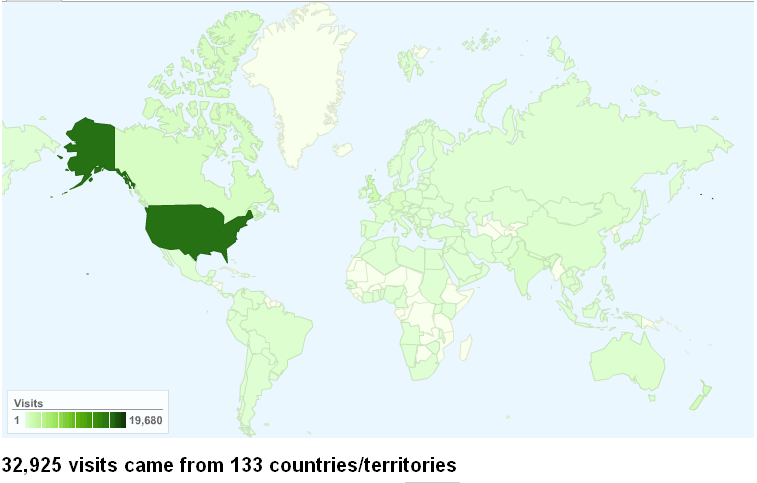 The Medical Hemostat Blog has gained wide geographical and company interest. You are welcome to contact me at hemostatguy@gmail.com. I also have consulted with market research firms such as Frost and Sullivan amongst other research organisations.
While I address a need for comprehensive information regarding hemostasis, I am pleased to announce our top, google analytics identified company visitors:
- Johnson & Johnson
- CryoLife
- Baxter
- Trauma Cure
- Tyco
- Zymogenetics
- Medafor
- Hemcon
- King Pharmaceuticals
- Entegrion
- St. Jude
- Aventis Behring
Thank You for following the Blog.
HG
Thursday, May 6, 2010
ZymoGenetics Webcast
SEATTLE, May 05, 2010 (BUSINESS WIRE) -- ZymoGenetics, Inc. announced today that Douglas E. Williams, Ph.D., Chief Executive Officer of ZymoGenetics, will present at the Bank of America Merrill Lynch Health Care Conference in New York City on Wednesday, May 12, 2010 at 10:40 a.m. Eastern Time.
A live webcast of the presentation can be accessed by going to: www.zymogenetics.com. The webcast will be archived for 30 days.
Wednesday, May 5, 2010
Zymogenetics Q1 2010 - "Soft" Hemostat Market in January
On the RECOTHROM front net sales for the quarter was $9 million. This is doubling of Q1 sales for 2009. January in particular was a very weak month across the hemostat segment and RECOTHROM was no exception. That said, for the quarter actual hospital demand that it's units moving from the wholesaler inventory to hospital end user increased by 14% compared to the fourth quarter of 2009.
RECOTHROM market share in dollars continued to increase in Q1 to approximately 19% versus 17% in the prior quarter. Jim will discuss the factors that influence our reported net sales for the March 31st quarter, but demand in market share continued to grow and based on momentum we see in the market place, we are comfortable with our full year guidance of $48 million to $54 million of net sales............
Net sales of RECOTHROM were $9 million for the quarter, doubling from $4.5 million a year ago. Net sales were approximately the same as the fourth quarter of 2009 even though we had positive trends in units sold to hospitals and market share as Doug described earlier.
There are two primary reasons for this, both of which were related to differences between the timing of hospital purchases and when we record revenue based on sales to wholesalers. First, decreases in wholesaler inventory levels had a significant impact. We estimated there were about 2.4 weeks of sales in the channel at March 31st, compared to about 3.2 weeks at the beginning of the quarter.
Second, the way that the weeks fell in the calendar had a significant impact, in that there was about one week fewer sales included in the three months ended March 31st compared to the three months ended December 31st. Together these two factors caused our reported net sales to be lower than one would expect based on underlying hospital sales trends.............
Brian Abrahams - Oppenheimer and Company
Great. Can you remind us how was [RECOTHROM] reimbursed and what impact the healthcare reforms would you expect?
Stephen Zaruby
Well, as three reimbursement was captured in the cost of any surgery we don’t see there will be any impact on the reform side at all in terms of our pricing and how we capture. So my guess, we are fortunate in that one of the few maybe who are not affected by that..........
David Miller - Biotech Stock Research
Now switching to RECOTHROM for a moment, can we expect the kind of continued slow grind we have seen for RECOTHROM sales on a quarter-over-quarter basis? Going forward, is there some kind of invents that we can look forward to that might provide an inflection or you would be replacing more of the JMI sales out there?
Stephen Zaruby
This is Stephen Zaruby. I think as Doug said we are encouraged by the momentum that we have seen, but moving forward obviously we are very active in the marketplace at all kinds and different touch points and levels be it through our sales force or national accounts people dealing with GPOs and so on and so forth and as Doug said we remain confident in our annual guidance and so it depends how you might forecast or sort of allocate our sales quarter-by-quarter, but we expect to see continued growth and the growth certainly comes largely or entirely at the expense of Thrombin-JMI........
Paul Latta - McAdams Wright Ragen
One another question on the RECOTHROM, you mentioned that the hemostat market was a little soft in January, any thought as to why?
Doug Williams
It's hard to say. I think it was sort of an observation we made looking at the totality of the markets. If you recall Paul we saw similar situation with our fourth quarter to first quarter situation last year, but I don’t know how much of it is sort of seasonally related, but I think beyond the metrics that Jim sketched out in terms of one less week and drawing down the wholesaler inventory levels. Those are really the sort of firm facts we can throw out and beyond that I think we just beat speculation as to what was happening in the market there, but quite clearly January for everyone in the hemostat area was a soft month.
Paul Latta - McAdams Wright Ragen
Is their [year-end] budget plus possibility too?
Doug Williams
Again it's hard to say. I think you could relate it to everything from bad weather on the East Coast to general economic conditions, but I think fundamentally we don't really have a clear-cut answer for you as to why January was soft.
Source: Seekingalpha
Friday, February 12, 2010
ZymoGenetics, Inc. Q4 2009
On the RECOTHROM front, we continue to gain market share and in January we published pooled safety and immunogenicity data across 8 different clinical studies in the Journal of the American College of Surgeons. This data further supports the safety and differentiation of RECOTHROM as a topical hemostat; we have recently been notified by FDA that they will require more time to analyze the mix of the citizen petition we filed in August which was inline with our expectations for their actions. Less visible but no less important will be the GMP manufacturing of the IL-31 monoclonal antibody and the initiation of IND enabling toxicology studies to support a first half 2011 IND Filing.
The company proceed of $13.6 million profits for the quarter which resulted from a one set of recognition at differed revenue related to restructuring of the their agreement. It was the positive quarter financially was increased RECOTHROM sale further reductions in ongoing operating expenses. A $94 million of cash inflow is from milestone payments.
All of our financial goals for the year ending with the strong cash position strengthen further by the additional $91 million rate of last month. Net sales of RECOTHROM increased $10.6 million for the quarter including 1.4 million (inaudible) to try the clinic launch in Canada. For the year sales of (inaudible) firm within our range of guidance further in asset sales to be included. At the hospital level we continue to see increasing demand in Q4, we estimated the growth that approximately 18% compared to the third quarter. Cognition and license revenue for the quarter were $51.2 million and the largest component of this total was the acceleration of $34 million related to their agreement.
The company proceed of $13.6 million profits for the quarter which resulted from a one set of recognition at differed revenue related to restructuring of the their agreement. It was the positive quarter financially was increased RECOTHROM sale further reductions in ongoing operating expenses. A $94 million of cash inflow is from milestone payments.
All of our financial goals for the year ending with the strong cash position strengthen further by the additional $91 million rate of last month. Net sales of RECOTHROM increased $10.6 million for the quarter including 1.4 million (inaudible) to try the clinic launch in Canada. For the year sales of (inaudible) firm within our range of guidance further in asset sales to be included. At the hospital level we continue to see increasing demand in Q4, we estimated the growth that approximately 18% compared to the third quarter. Cognition and license revenue for the quarter were $51.2 million and the largest component of this total was the acceleration of $34 million related to their agreement.
Monday, January 11, 2010
ZymoGenetics Closes $90M Deal
ZymoGenetics, the Seattle-based biotech company, said today its underwriters have exercised their options to buy all the shares they were granted, bringing its net proceeds from the latest offering to $90.9 million. Investors and underwriters bought a total of 16.1 million shares at $6 apiece, ZymoGenetics said. The money will be used to support R&D, and to help market the company's lone approved drug, recombinant thrombin (Recothrom).
Thursday, January 7, 2010
ZymoGenetics to sell 12 million shares
Jan 6 (Reuters) - Biotechnology firm ZymoGenetics Inc (ZGEN.O) said it will sell 12 million common shares in a public offering. Shares of the company fell 11 percent to $6.00 in trading after the bell. The proposed offering amounts to about 17 percent of the company's total outstanding shares of about 69.3 million as of Oct. 30, 2009. The company plans to grant underwriters an over-allotment option to purchase up to an additional 1.8 million shares. A portion of the net proceeds from the offering will be used to support the commercialization of its synthetic blood-clotting enzyme Recothrom, the company said in a statement.
Saturday, December 19, 2009
ZymoGenetics shares fall on regulatory delay
Shares of ZymoGenetics Inc. dipped Tuesday after the company said additional studies are likely needed to gain European regulatory approval of its only marketed product, Recothrom.
Sales of the drug, which is used to control bleeding during surgical procedures, climbed to $8.5 million from $1.8 million during the third quarter. While approved in the U.S., it is not yet approved in Europe. Seattle-based ZymoGenetics licensed all rights outside of the U.S. to Germany-based Bayer in 2007.
In a Securities and Exchange Commission filing Monday, ZymoGenetics said Bayer pulled its application with European regulators as a response to indications that the drug candidate would take an additional study to gain approval.
The Committee for Medicinal Products for Human Use said Bayer's submission did not meet the necessary standards.
The stock fell 13 cents, or just under 2 percent, to $6.61 in afternoon trading. ZymoGenetics shares have traded between $2.55 and $7.31 over the last 52 weeks.
Sales of the drug, which is used to control bleeding during surgical procedures, climbed to $8.5 million from $1.8 million during the third quarter. While approved in the U.S., it is not yet approved in Europe. Seattle-based ZymoGenetics licensed all rights outside of the U.S. to Germany-based Bayer in 2007.
In a Securities and Exchange Commission filing Monday, ZymoGenetics said Bayer pulled its application with European regulators as a response to indications that the drug candidate would take an additional study to gain approval.
The Committee for Medicinal Products for Human Use said Bayer's submission did not meet the necessary standards.
The stock fell 13 cents, or just under 2 percent, to $6.61 in afternoon trading. ZymoGenetics shares have traded between $2.55 and $7.31 over the last 52 weeks.
Friday, December 4, 2009
Zymogenetics cuts back staff to focus on Recothrom
ZymoGenetics is cutting all of its immunology work along with 15 percent of its jobs, or 52 positions. That's in addition to the 161 jobs the developer cut in April when it decided to bow out of the cancer research business. All ongoing immunology discovery research programs will be discontinued; however, the company will keep the research capabilities necessary to support the ongoing development programs for current product candidates.
According to the regulatory filing, cutting new immunology research will allow the developer to focus on its sole marketed product, Recothrom Thrombin, a treatment for surgical bleeding. It will also give ZymoGenetics more resources for developing and commercializing its pipeline of clinical and preclinical product candidates. In a statement emailed to Xconomy, a spokesperson said that the company has abandoned the strategy of discovering and licensing out many early-stage candidates. Now it will focus on fewer programs that it will advance to later stages. The spokesperson added that the company is focusing on drug candidates that have the most potential over the next three to four years.
ZymoGenetics's reductions will result in an annual expense savings of $8 million to $10 million, in addition to the estimated $30 million in savings generated by the April restructuring. This round of layoffs leaves the developer with about 300 employees, according to Xconomy.
According to the regulatory filing, cutting new immunology research will allow the developer to focus on its sole marketed product, Recothrom Thrombin, a treatment for surgical bleeding. It will also give ZymoGenetics more resources for developing and commercializing its pipeline of clinical and preclinical product candidates. In a statement emailed to Xconomy, a spokesperson said that the company has abandoned the strategy of discovering and licensing out many early-stage candidates. Now it will focus on fewer programs that it will advance to later stages. The spokesperson added that the company is focusing on drug candidates that have the most potential over the next three to four years.
ZymoGenetics's reductions will result in an annual expense savings of $8 million to $10 million, in addition to the estimated $30 million in savings generated by the April restructuring. This round of layoffs leaves the developer with about 300 employees, according to Xconomy.
Friday, November 6, 2009
Sometimes only the Lawyers win.......ZymoGenetics says restraining orders lifted
ZymoGenetics Inc. said Friday that a federal judge in Tennessee has removed three temporary restraining orders imposed on the company over marketing and promotion of its lead drug, Recothrom.
The Seattle biotechnology company (NASDAQ: ZGEN) on Wednesday disclosed that it had been slapped with the restraining orders as part of a lawsuit filed by four companies, including rival King Pharmaceuticals Inc. The lawsuit accuses ZymoGenetics of unfair competition, false advertising, trademark infringement and related claims, ZymoGenetics said.
In a filing Friday with the Securities and Exchange Commission, ZymoGenetics said the judge in Tennessee had vacated the restraining orders, which "have no further force or effect." The company did not elaborate, but said it disputes the lawsuit's allegations and intends to "vigorously defend" itself at a hearing in the case scheduled for Nov. 16.
ZymoGenetics on Thursday said third-quarter revenue increased 131 percent, to $8.5 million, from the same quarter a year ago, due to sales of Recothrom, a bleeding-control drug. The company narrowed its Q3 loss to $11.4 million, or 17 cents a share, from a loss of $28.8 million, or 42 cents a share, in the year-ago quarter.
The Seattle biotechnology company (NASDAQ: ZGEN) on Wednesday disclosed that it had been slapped with the restraining orders as part of a lawsuit filed by four companies, including rival King Pharmaceuticals Inc. The lawsuit accuses ZymoGenetics of unfair competition, false advertising, trademark infringement and related claims, ZymoGenetics said.
In a filing Friday with the Securities and Exchange Commission, ZymoGenetics said the judge in Tennessee had vacated the restraining orders, which "have no further force or effect." The company did not elaborate, but said it disputes the lawsuit's allegations and intends to "vigorously defend" itself at a hearing in the case scheduled for Nov. 16.
ZymoGenetics on Thursday said third-quarter revenue increased 131 percent, to $8.5 million, from the same quarter a year ago, due to sales of Recothrom, a bleeding-control drug. The company narrowed its Q3 loss to $11.4 million, or 17 cents a share, from a loss of $28.8 million, or 42 cents a share, in the year-ago quarter.
Thursday, November 5, 2009
King Pharmaceuticals Inc has sued ZymoGenetics Inc
Nov 4 (Reuters) - King Pharmaceuticals Inc has sued ZymoGenetics Inc seeking damages and injunctive relief, alleging trademark infringement among other things, and a U.S. court has temporarily restrained Zymogenetics from marketing a product, according to a regulatory filing.
ZymoGenetics said in the filing that the three temporary restraining orders (TROs), passed on Nov. 3 without hearing its side, were prohibiting it from engaging in certain marketing or promotional conducts related to Recothrom, its hemostasis aid.
ZymoGenetics said King, in the suit filed in a federal court in Tennessee, alleged Zymogenetics of engaging in unfair competition, false advertising, trademark infringement and other related claims.
"We are seeking immediate relief from the court to vacate the TROs, and we will seek an immediate hearing on this motion," ZymoGenetics said in the filing.
A hearing on King's motions for preliminary injunctive relief is scheduled for Nov. 16, and ZymoGenetics will oppose King's request for preliminary injunctive relief, it said.
"We currently believe that this litigation will not have a material adverse effect on our financial condition, our results of operation, or our cash flows," ZymoGenetics added.
ZymoGenetics said in the filing that the three temporary restraining orders (TROs), passed on Nov. 3 without hearing its side, were prohibiting it from engaging in certain marketing or promotional conducts related to Recothrom, its hemostasis aid.
ZymoGenetics said King, in the suit filed in a federal court in Tennessee, alleged Zymogenetics of engaging in unfair competition, false advertising, trademark infringement and other related claims.
"We are seeking immediate relief from the court to vacate the TROs, and we will seek an immediate hearing on this motion," ZymoGenetics said in the filing.
A hearing on King's motions for preliminary injunctive relief is scheduled for Nov. 16, and ZymoGenetics will oppose King's request for preliminary injunctive relief, it said.
"We currently believe that this litigation will not have a material adverse effect on our financial condition, our results of operation, or our cash flows," ZymoGenetics added.
Monday, October 26, 2009
ZymoGenetics’ Former Medical Boss Leads Rival Startup, ProFibrix
One of the key people who transformed ZymoGenetics from a basic research institute into a more balanced biotech company with both R and D, has set up shop in a rival startup just a few blocks away on Seattle’s Eastlake Avenue. If he plays his cards right, this little company will surpass his former employer, with what he hopes will be an even better treatment to control bleeding.
His name is Jan Öhrström (pronounced Yahn Oar-strum), and he’s the former chief medical officer of Seattle-based ZymoGenetics (NASDAQ:ZGEN), and now the chief operating officer of a company calledProFibrix. The newer company is headquartered in the Netherlands, and when it went looking to establish a U.S. presence a year ago, it hooked up with Öhrström to build that in Seattle. The company picked up some momentum in August when it raised $11 million in a Series B venture round, and it has some intriguing technology, so it was time to catch up with Öhrström over lunch to find out what’s up.
ProFibrix sees itself carving out a niche in the market for drugs and sealants that are used to stop excess bleeding, both in the surgical operating room and among paramedics—or on the military battlefield. The company is creating a dry powder that is ready to be used at a moment’s notice, can be sprinkled on a wound, remains stable at room temperature, and can be packaged in a spray or a bandage. It sees its potential edge in convenience when going up against standard treatments that need to be thawed, mixed with another solution, or kept in a fridge. If this new product can be proven effective in clinical trials, ProFibrix will tap into a couple different market segments worth about $600 million a year combined in the U.S.
“There’s no doubt about it, we can make significant inroads in the market,” Öhrström says.
Jan Ohrstrom
When we met over lunch near his home on Mercer Island, Öhrström was excited about getting ProFibrix set up in a new office on Eastlake, complete with all the usual mundane aspects of a startup—getting the lease signed, phones working, and the office furniture assembled (I could relate this part to when Greg and I got the Xconomy Seattle office up and running in June 2008.)
ZymoGenetics is well known for its blood coagulation expertise, although its Recothrom drug has gotten off to a slow start in sales. ProFibrix CEO Jaap Koopman, it turns out, had been cultivating a relationship with Öhrström for years, dating back to when Ohrstrom oversaw the development of recombinant thrombin (Recothrom). The vision was that if ProFibrix could get Ohrstrom on board—somebody who had technical knowledge of coagulation, expertise in leading drug development, and the experience of doing the IPO roadshow for ZymoGenetics back in 2002—then ProFibrix would have somebody who could help it attract more U.S. scientific talent, and get on the radar of U.S.-based investors.
What attracted Öhrström to the new company was ProFibrix’s lead drug candidate, which it calls Fibrocaps. It’s a tissue sealant that is derived from a pair of clotting proteins found in human blood—fibrinogen and thrombin. ProFibrix gathers those proteins from human blood, and spray dries them through a proprietary manufacturing process. That makes them into microparticles in a dry powder, which is stable at room temperature, and just needs a little liquid added (like what is found at a bleeding site) for it to spring into action and start clotting.
This sort of thing could be used by surgeons to control excess bleeding, like the ZymoGenetics drug, and could also be used by paramedics or Army medics who need something quick and convenient to stop bleeding fast, Öhrström says. It would offer a convenient alternative to fibrin sealants made by Baxter Healthcare and Johnson & Johnson, which require thawing or heating, or some kind of mixing or application device, he says.
Convenience is a big part of the story, but Öhrström got more animated talking about the science. Liquid coagulants sometimes have the disadvantage of being applied to a highly viscous bleeding site on the body, and they can run off. When these types of liquid tissue sealants are made into a spray applicator, they also sometimes clog up on the tip and don’t spray very well, Öhrström says.
The ProFibrix microparticles have the physical advantage of being able to embed themselves in any number of difficult situations that doctors and paramedics might face. “When you have a bleeding surface, it’s rarely flat. It’s got crevices,” Ohrstrom says. “A dry powder can conform to any surface.”
OK, so what kind of evidence does ProFibrix have to prove this concept? Not a lot yet. It started enrolling the first of about 20 patients in a clinical trial in June, and hopes to have results in hand by the end of this year. If it can stick to what Öhrström calls “an ambitious timeline,” then it will start a mid-stage trial in 2010 that can roll over into a pivotal study. That trial could form the basis for a new drug application to the FDA by late 2011 or early 2012, he says.
The ProFibrix group in Seattle will likely remain small, Öhrström says. The company has already recruited Linda Zuckerman from ZymoGenetics to head all preclinical development, and it will look to assemble a small team of maybe six to eight people with expertise in drug development, regulatory affairs, and business development. It doesn’t expect to have labs here. “We want to keep the payroll lean,” Öhrström says.
I had to ask Öhrström how he manages in a trans-Atlantic company, with headquarters that operate nine hours ahead of him. Ohrstrom, who is from Denmark, is used to it from his days working with Denmark-based Novo Nordisk before he joined ZymoGenetics. The new job requires that he travel a fair bit to the Netherlands, but he says he doesn’t mind, and it is actually not too much of a strain on his family life.
“My wife is Dutch, and she has family in Holland, so she’s very supportive,” Öhrström says with a laugh.
His name is Jan Öhrström (pronounced Yahn Oar-strum), and he’s the former chief medical officer of Seattle-based ZymoGenetics (NASDAQ:ZGEN), and now the chief operating officer of a company calledProFibrix. The newer company is headquartered in the Netherlands, and when it went looking to establish a U.S. presence a year ago, it hooked up with Öhrström to build that in Seattle. The company picked up some momentum in August when it raised $11 million in a Series B venture round, and it has some intriguing technology, so it was time to catch up with Öhrström over lunch to find out what’s up.
ProFibrix sees itself carving out a niche in the market for drugs and sealants that are used to stop excess bleeding, both in the surgical operating room and among paramedics—or on the military battlefield. The company is creating a dry powder that is ready to be used at a moment’s notice, can be sprinkled on a wound, remains stable at room temperature, and can be packaged in a spray or a bandage. It sees its potential edge in convenience when going up against standard treatments that need to be thawed, mixed with another solution, or kept in a fridge. If this new product can be proven effective in clinical trials, ProFibrix will tap into a couple different market segments worth about $600 million a year combined in the U.S.
“There’s no doubt about it, we can make significant inroads in the market,” Öhrström says.
Jan Ohrstrom
When we met over lunch near his home on Mercer Island, Öhrström was excited about getting ProFibrix set up in a new office on Eastlake, complete with all the usual mundane aspects of a startup—getting the lease signed, phones working, and the office furniture assembled (I could relate this part to when Greg and I got the Xconomy Seattle office up and running in June 2008.)
ZymoGenetics is well known for its blood coagulation expertise, although its Recothrom drug has gotten off to a slow start in sales. ProFibrix CEO Jaap Koopman, it turns out, had been cultivating a relationship with Öhrström for years, dating back to when Ohrstrom oversaw the development of recombinant thrombin (Recothrom). The vision was that if ProFibrix could get Ohrstrom on board—somebody who had technical knowledge of coagulation, expertise in leading drug development, and the experience of doing the IPO roadshow for ZymoGenetics back in 2002—then ProFibrix would have somebody who could help it attract more U.S. scientific talent, and get on the radar of U.S.-based investors.
What attracted Öhrström to the new company was ProFibrix’s lead drug candidate, which it calls Fibrocaps. It’s a tissue sealant that is derived from a pair of clotting proteins found in human blood—fibrinogen and thrombin. ProFibrix gathers those proteins from human blood, and spray dries them through a proprietary manufacturing process. That makes them into microparticles in a dry powder, which is stable at room temperature, and just needs a little liquid added (like what is found at a bleeding site) for it to spring into action and start clotting.
This sort of thing could be used by surgeons to control excess bleeding, like the ZymoGenetics drug, and could also be used by paramedics or Army medics who need something quick and convenient to stop bleeding fast, Öhrström says. It would offer a convenient alternative to fibrin sealants made by Baxter Healthcare and Johnson & Johnson, which require thawing or heating, or some kind of mixing or application device, he says.
Convenience is a big part of the story, but Öhrström got more animated talking about the science. Liquid coagulants sometimes have the disadvantage of being applied to a highly viscous bleeding site on the body, and they can run off. When these types of liquid tissue sealants are made into a spray applicator, they also sometimes clog up on the tip and don’t spray very well, Öhrström says.
The ProFibrix microparticles have the physical advantage of being able to embed themselves in any number of difficult situations that doctors and paramedics might face. “When you have a bleeding surface, it’s rarely flat. It’s got crevices,” Ohrstrom says. “A dry powder can conform to any surface.”
OK, so what kind of evidence does ProFibrix have to prove this concept? Not a lot yet. It started enrolling the first of about 20 patients in a clinical trial in June, and hopes to have results in hand by the end of this year. If it can stick to what Öhrström calls “an ambitious timeline,” then it will start a mid-stage trial in 2010 that can roll over into a pivotal study. That trial could form the basis for a new drug application to the FDA by late 2011 or early 2012, he says.
The ProFibrix group in Seattle will likely remain small, Öhrström says. The company has already recruited Linda Zuckerman from ZymoGenetics to head all preclinical development, and it will look to assemble a small team of maybe six to eight people with expertise in drug development, regulatory affairs, and business development. It doesn’t expect to have labs here. “We want to keep the payroll lean,” Öhrström says.
I had to ask Öhrström how he manages in a trans-Atlantic company, with headquarters that operate nine hours ahead of him. Ohrstrom, who is from Denmark, is used to it from his days working with Denmark-based Novo Nordisk before he joined ZymoGenetics. The new job requires that he travel a fair bit to the Netherlands, but he says he doesn’t mind, and it is actually not too much of a strain on his family life.
“My wife is Dutch, and she has family in Holland, so she’s very supportive,” Öhrström says with a laugh.
Friday, September 11, 2009
Sunday, September 6, 2009
Zymogenetics - Webcast
SEATTLE--(Business Wire)--
ZymoGenetics, Inc. (NASDAQ:ZGEN) announced today that senior executives will provide updates on company activities at two upcoming investor conferences. James A. Johnson, Executive Vice President and Chief Financial Officer, will
present at the Thomas Weisel Partners Healthcare Conference in Boston on Thursday, September 10, 2009 at 3:15 p.m. Eastern Time. Douglas E. Williams, Ph.D., Chief Executive Officer, will present at the UBS Global Life Sciences Conference in New York City on Wednesday, September 23, 2009 at 9:30 a.m. Eastern Time.
ZymoGenetics, Inc. (NASDAQ:ZGEN) announced today that senior executives will provide updates on company activities at two upcoming investor conferences. James A. Johnson, Executive Vice President and Chief Financial Officer, will
present at the Thomas Weisel Partners Healthcare Conference in Boston on Thursday, September 10, 2009 at 3:15 p.m. Eastern Time. Douglas E. Williams, Ph.D., Chief Executive Officer, will present at the UBS Global Life Sciences Conference in New York City on Wednesday, September 23, 2009 at 9:30 a.m. Eastern Time.
Live webcasts of the presentations can be accessed by going to:
www.zymogenetics.com. The webcasts will be archived for 30 days.
Friday, September 4, 2009
Safety of topical thrombins: the ongoing debate
Until recently, only bovine-derived thrombin was available for use as a stand-alone topical hemostat or as a component of other hemostatic devices. Concerns over a number of case reports of immune-mediated coagulopathies associated with the use of bovine-derived thrombin resulted in a United States Food and Drug Administration warning letter being issued in 1996 and the later addition of a boxed warning ("Black Box Warning") to all bovine-derived thrombin products.
Since 2007, both a human-pooled plasma thrombin product and a recombinant thrombin have entered the market.With the addition of these two products to the topical thrombin class, a unique situation has developed in which only a single member (bovine-derived thrombin) within the class carries the Food and Drug Administration's strongest cautionary language about possible adverse events related to an agent's use. Neither the human-pooled plasma thrombin nor the recombinant thrombin products have a boxed warning; although, the human-pooled plasma product does include a precaution/warning about infectious agent transmission - a warning common to products derived from human sources.
This report will address this unique situation and the impact, clinical and non-clinical, that thrombin choice may have. Since alternatives are now available, institutions may need to revisit their formulary choice of thrombin preparation, taking into consideration the potential risks associated with bovine-derived products.
Since 2007, both a human-pooled plasma thrombin product and a recombinant thrombin have entered the market.With the addition of these two products to the topical thrombin class, a unique situation has developed in which only a single member (bovine-derived thrombin) within the class carries the Food and Drug Administration's strongest cautionary language about possible adverse events related to an agent's use. Neither the human-pooled plasma thrombin nor the recombinant thrombin products have a boxed warning; although, the human-pooled plasma product does include a precaution/warning about infectious agent transmission - a warning common to products derived from human sources.
This report will address this unique situation and the impact, clinical and non-clinical, that thrombin choice may have. Since alternatives are now available, institutions may need to revisit their formulary choice of thrombin preparation, taking into consideration the potential risks associated with bovine-derived products.
Subscribe to:
Posts (Atom)