Showing posts with label Traumacure. Show all posts

Monday, May 24, 2010

Hemostasis Blog Valued Resource!

The Medical Hemostat Blog has gained wide geographical and company interest. You are welcome to contact me at hemostatguy@gmail.com. I also have consulted with market research firms such as Frost and Sullivan amongst other research organisations.

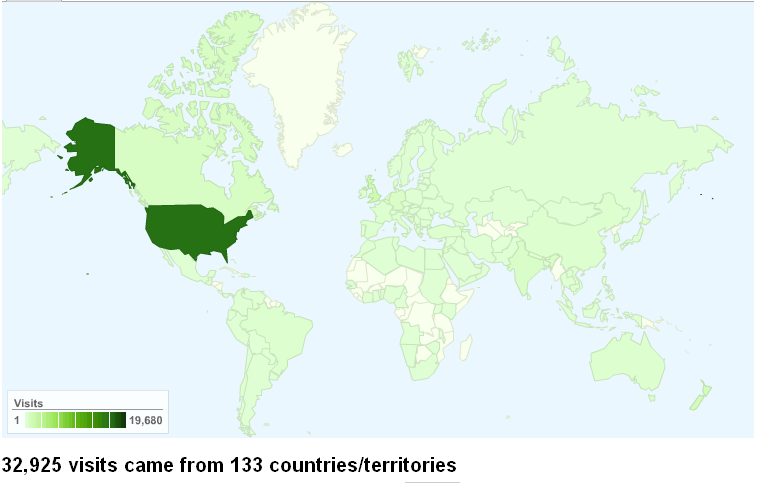
While I address a need for comprehensive information regarding hemostasis, I am pleased to announce our top, google analytics identified company visitors:

  1. Johnson & Johnson
  2. CryoLife
  3. Baxter
  4. Trauma Cure
  5. Tyco
  6. Zymogenetics
  7. Medafor
  8. Hemcon
  9. King Pharmaceuticals
  10. Entegrion
  11. St. Jude
  12. Aventis Behring
I would appreciate any contributions readers care to send and am actively seeking projects in this field.
Thank You for following the Blog.
HG

Monday, February 2, 2009

Woundstat halted by US army

WASHINGTON — Until more testing can be done, Army medics are being told to stop using a new product just sent to the war front to help control bleeding among wounded troops.
Officials were in the process of distributing some 17,000 packets of WoundStat, granules that are poured into wounds when special bandages, tourniquets or other efforts won't work. But a recent study showed that, if used directly on injured blood vessels, the granules may lead to harmful blood clots, officials said Tuesday.
The Army Medical Command will continue its research and work with the manufacturer in hopes of figuring out in the next few months whether to resume use of WoundStat, said Col. Paul Cordts, head of Army health policy and services.
WoundStat manufacturer TraumaCure, Inc., of Bethesda, Md., had no immediate comment.
The product had been approved by the U.S. Food and Drug Administration. It was one of the latest in a series of Army efforts to improve survival rates on the battlefield.
Today, 90 percent of injured troops survive their wounds, the highest rate of any war, Cordts said in an interview. He credited better training of combat medics, better body armor the troops wear and better tactics they use on the battlefield, as well improved bandages, tourniquets and so on.
Defense Department figures show that as of this month, more than 4,800 troops have been killed in Iraq and the global war on terror. The latter category counts casualties mostly from Afghanistan. Some 34,000 troops have been wounded in the wars, where insurgents have made wide use of roadside bombs and other explosives.
Excessive blood loss is the number one killer on the battlefield, and the Army announced in October that it was sending two potential lifesavers ‹ the WoundStat packets and a bandage called Combat Gauze to replace older other products that had been in use at the time.
A committee of Army medics, Navy corpsmen, surgeons and others recommended the Combat Gauze bandage which has an agent that triggers blood clotting should be the first-line treatment for life-threatening hemorrhaging in cases where a tourniquet could not be placed, such as the armpit or groin area.
The WoundStat granules were to be used if the bandage failed to work.
Cordts said the Army put out a message on Dec. 18, directing the temporary halt in use of WoundStat. Though it has arrived at the war zones, officials are unclear on how widely it has been distributed so far. They¹re working to identify any soldiers who got the treatment, study their cases and examine them for any problems with blood clotting, Cordts said.
He said he didn't know whether it had been used on any soldiers and thus had no reports back from the field positive or negative on how effective it might have been.
Cordts said that after an additional few months of study, officials will likely determine whether they should discontinue its use altogether or perhaps redistribute it with warnings for how it is to be used.

Tuesday, September 23, 2008

TraumaCure Receives CE Mark Clearance to Sell WoundStat in Europe

TraumaCure Inc. announced today that its ground-breaking hemostatic agent, WoundStat™, has received CE Mark approval, clearing the way for sales in the European Union and all countries recognizing the CE Mark. CE Mark approval from the European Union certifies WoundStat has met health, safety and environmental requirements for consumer safety.

Tuesday, September 16, 2008

TraumaCure Receives Health Canada Licensure

TraumaCure Inc. today announced that Health Canada has issued a medical device license for WoundStat™, a ground-breaking hemostatic agent for control of bleeding in high-pressure arterial wounds. The availability of WoundStat in Canada enables military, emergency medical services, law enforcement services, rescue services, and other first responders to stop arterial bleeding within seconds and stabilize an injured person, giving the time needed to seek advanced medical help and save lives.
TraumaCure also announced an exclusive distributor agreement with Canadian Tactical and Operational Medical Solutions Inc. (CTOMS), the highly regarded provider of Combat Casualty Care training and supplier of high quality medical equipment, to make WoundStat immediately available throughout Canada. CTOMS is based in Edmonton, Alberta

Tuesday, June 24, 2008

TraumaCure Receives Prestigious ISO 13485 Certification


BETHESDA, Md.--(BUSINESS WIRE)--TraumaCure Inc. – makers of the ground-breaking hemostatic agent, WoundStat™ – today announced that the company has received the prestigious international ISO 13485 certification for its quality system for design, development, production and sales of medical devices. The company received FDA clearance to sell WoundStat in August 2007
With ISO 13485 certification, TraumaCure meets global quality design and manufacturing requirements. ISO certification is a base-line requirement in many key markets for approval to sell a medical device and therefore supports TraumaCure’s plans to market WoundStat to nations around the world.
“As the only hemostatic agent proven to be 100% effective in four different studies, we are seeing worldwide demand for WoundStat,” said Devinder Bawa, CEO of TraumaCure. “TraumaCure has put the processes and procedures in place to ensure the global availability of a consistent, safe, and effective product that is ready to save lives, anytime and anywhere it is needed.”
ISO (International Organization for Standardization) is the world's largest developer and publisher of International Standards. ISO has more than 16,500 International Standards in its current portfolio, ranging from standards for traditional activities, such as agriculture and construction, through mechanical engineering, manufacturing and distribution, to transport, medical devices, the environment, safety, information and communication technologies, and to standards for good practice and for services.
ISO 13485 is an internationally recognized quality standard for the design, development, production, and sales of medical devices. To be certified, organizations must demonstrate an ability to provide medical devices and related services that consistently meet customer and regulatory requirements.
TraumaCure was certified after rigorous audits and extensive document reviews to ensure that TraumaCure’s quality management system (QMS) is run in accordance with the globally recognized standard.

Tuesday, June 3, 2008

US Department of Defense Recommends Soldiers Carry WoundStat™


BETHESDA, Md.--(BUSINESS WIRE)--TraumaCure Inc. announced today that the DOD Joint Committee on Tactical Combat Casualty Care (CoTCCC) has recommended that U.S. soldiers from all services carry the company’s hemostatic agent, WoundStat™. The CoTCCC based its recommendations upon the results of extensive studies conducted by both the Army’s Institute for Surgical Research (ISR) and the Naval Medical Research Center (NMRC). In those studies, no other product was as effective across the board in terms of survival, post treatment blood loss, and duration of hemostasis.
This is the first time ever that all branches of the military have come together and jointly recommended the same product for the most severe injuries involving high-pressure bleeding.
“Severe bleeding is the number one cause of death for soldiers injured in battle. The ISR study clearly shows WoundStat works consistently to stop serious bleeding quickly. In light of these study results, WoundStat will be a critical product in the field available to all soldiers in harm’s way, where and when it is needed most,” said Ron Blanck, retired US Army Surgeon General. “Approximately 80% of injuries in the current conflict are from improvised explosive devices (IEDs), which result in the severe and irregular wounds that WoundStat is specifically designed to treat. In those situations, WoundStat works in seconds, not minutes.”
Four different studies—including the one conducted by the Army’s ISR, along with others conducted at Virginia Commonwealth University, the Air Force, and NAMSA—have now proven that WoundStat is the most effective hemostat available for high pressure arterial wounds. In each of these studies, WoundStat was the only product that resulted in 100% survival. The novel wound treatment works through standing blood and has the added advantage that, should re-bleeding occur, a wound can be re-packed with the WoundStat already present—a real advantage in combat conditions.
“The Joint Committee on TCCC recognized WoundStat’s overall advantage in both effectiveness and safety. It is now clearly proven that, with its consistent reliability and efficacy, combined with its speed of use, WoundStat offers the highest level of operational field capability for our warfighters,” noted Devinder S. Bawa, CEO of TraumaCure.
TraumaCure has enough WoundStat in stock to equip every soldier currently deployed in the Middle East theater. The cost of WoundStat is about one-third that of the product the Army has been using for the past several years. WoundStat is also available for domestic use by emergency responders and others who need to be prepared for treating traumatic injuries.

Sunday, March 2, 2008

Woundstat

WoundStat was developed in VCU Medical Center's Reanimation Engineering Shock Center, which does research on treating critical illness and injury. Part of the center, Operation Purple Heart, focuses on treating combat casualties.
"We took a step back and examined what the strengths and weaknesses were with the current (blood-stopping) products that were out there to see if there was something we could improve upon," said Dr. Kevin Ward, an emergency physician and the shock center's associate director.
Ward and two colleagues - biochemist Robert Diegelmann and biomedical engineer Gary Bowlin - developed a tan-colored concoction of minerals that looks like a cross between flour, sand and cat litter. After its use, WoundStat can be peeled off the wound.
The researchers were introduced to Jack McDonnell, who licensed the technology and established a company called TraumaCure in May 2006.
McDonnell expects the Food and Drug Administration to approve WoundStat by October, after which TraumaCure will market its product to the military, firefighters and police departments.
Blanck, the retired surgeon general and an outside director of TraumaCure, said current hemorrhage-stopping products - specifically, HemCon and QuikClot - have been a step in the right direction but that there is room for improvement.
"I'm not critical of them because I think they've been responsible for saving lives. Our goal is to save even more," he said.
A spokeswoman for HemCon said its standard-issue bandages work best on large, high-blood flow wounds but are limited on smaller but serious injuries such as a gunshot. QuikClot clots blood but produces a reaction when used that creates excessive heat, and studies have found that it may damage organs and tissues.
An independent study by the Army's Institute of Surgical Research found WoundStat to be a highly effective wound dressing that doesn't produce a heat reaction. The report said the product's primary limitation is that it will stop blood flow on damaged vessels, acting as a granular tourniquet in areas where an actual tourniquet cannot be tied, such as the groin.
Please find the FDA 510K approved 2007 HERE