Saturday, July 11, 2009

Glues tailored to specific tissues

Surgical adhesives, which can be used to seal tissues after an operation or to repair wounds, are becoming increasingly important parts of a doctor's toolkit. However, their one-size-fits-all nature means that existing adhesives, or glues, work well in some cases but not in others.
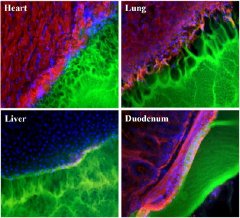
Images showing the interface between a surgical glue (green) and tissue samples (red, blue and black) from the heart, lung, liver, and duodenum. The glue works best with duodenum tissue (note smooth interface), and worst with lung tissue (pockmarked with holes).

MIT researchers aim to change that with glues tailored to specific tissues. In a recent issue of Advanced Materials, they identified for the first time how one kind of glue material bonds to tissue and how that adhesion varies depending on the tissue involved, from the intestine to the lung. They then showed how by adjusting certain properties of the materials it was possible to create a range of adhesives optimized for specific tissues and applications.

"The delineation of tissue-specific mechanisms for material adhesion leads the way for tailoring materials to individual needs and applications. This exciting work may well change the clinical use and continued evolution of soft-tissue sealants and adhesive materials," said Elazer R. Edelman, principal investigator and MIT's Thomas D. and Virginia W. Cabot Professor of Health Sciences and Technology.

Adhesive sealants could improve patient care and reduce healthcare costs by cutting medical complications after surgery, such as leakage through incisions, and improved wound healing, according to Natalie Artzi, a postdoctoral associate who led the research in Edelman's lab.

Although there is already a billion-dollar market for such adhesives, "they haven't reached their true potential," Artzi said. Existing materials have limitations that often force doctors to compromise between adhesion strength and tissue reaction. For example, said Artzi, for a given tissue, the material may be adhesive but release toxins that could affect healing. Alternatively, the material could be quite tissue compatible, but degrade quickly, becoming non-adhesive. If the glue doesn't work, a doctor must switch to sutures or staples.

The problem, according to the MIT team is that while surgical adhesives rely on intimate interactions between the adhesive and the tissue in question, the properties of the target tissue have been largely ignored in designing adhesives. Instead, "one general formulation is proposed for application to the full range of soft tissues across diverse clinical applications," Artzi and colleagues wrote in their Advanced Materials paper.

The new work characterized a variety of interactions between one kind of glue (hyrogels composed of polyethylene glycol and dextran aldehyde, or PEG: dextran for short) and tissue from a rat's heart, lung, liver and duodenum (the first section of the intestine). The team found, for example, that the glue worked well with tissue from the duodenum, but poorly with that from the lung.

They then went on to "identify the functional groups in the material that are responsible for adhesion with tissue functional groups, and created a model to optimize adhesion for each tissue," Artzi said. In particular the paper explains how variation of chemical reactive groups in the material could be matched to the variability in the density of respective reactive groups on different tissues to regulate tissue-material interaction.

The team will use these findings to "develop a platform of adhesive materials" for specific tissues. Although it could take three to five years before the work translates into a product, "the concept is there," she concluded.

In addition to Edelman and Artzi, co-authors of the paper are Tarek Shazly (co-first author with Artzi and a graduate student in MIT's Department of Materials Science and Engineering), Aaron B. Baker (a postdoctoral associate in Edelman's lab), and Adriana Bon, now at the Universitat Ramon Llull (Spain).

The work was supported by the MIT-DuPont Alliance and the National Institutes of Health, as well as the Philip Morris External Research Program.

Wednesday, July 8, 2009

New Ultra-Thin Surgical Patch Has Endless Possibilities

Throughout the decades, surgeons have typically used stitches and staples to close up wounds. They may even use sheets several millimeters thick coated with fibrin, a protein that makes blood clot and is glue-like but which can cause unwanted sticking to nearby tissue.

Now, Japanese scientists have revealed a new, cutting edge surgical ‘nano-sheet’ they have developed that is one thousand times thinner than Cellophane that can patch up internal wounds before dissolving inside the body.

This transparent adhesive sheeting is made from a substance derived from crab shells and a viscous gum from algae and is only 75 nanometers thick. A nanometer is one-billionth of one meter.

"This is the world's thinnest adhesive plaster," said Toshinori Fujie, a researcher involved in the joint project by Tokyo's private Waseda University and the National Defense Medical College.


"We know food Cellophane clings on to the surface of various objects. We have made a sheet ultimately thin... so that it is highly flexible and can stick to organs well with no glue," he told AFP.

The experiment, which was repeated several times, consisted of using the new nano-sheet to patch a six-millimeter-wide hole in a dog’s lung.

The sheet proved to have the strength to stand up under the pressure of the dog’s respiration and allow the wounds to heal within a month without a visible trace, according to Fujie.

Researchers hope to launch human clinical trials in three years.

The sheets might also prove to be useful in treating external wounds in the future as well.

"Organs repaired with this sheet do not have scars, unlike after stitches," Fujie said. "We believe this could also be true on the skin."

If the tests show that it is effective externally, it could open up a world of applications such as being applied to wounds from surgery in breast cancer patients, he said.

"Some people also want to use this for treating bed sores. The next application will definitely be on the skin," he said.

Fujie says that the inventors have been exploring all possibilities, even cosmetic uses such as stretching out wrinkles or holding skin conditioners in place.

"As this is transparent on the skin, you could be wearing a face pack while working in the office," he said.

Saturday, July 4, 2009

Analyst predicts - "high-strength, elastic glue without toxicity concerns would revolutionize the market"


Approximately 70 million surgical and procedure-based wounds are created each year in surgeries worldwide that offer potential for adjunctive products for surgical closure and securement. Some 23 million of these wounds are created during surgical procedures in the United States. Although it is possible that healing of all these wounds would be improved through use of adjunctive products for surgical closure and securement, use of the most advanced of these products has been limited to a fraction of these procedures. For example, there are approximately 3 million procedures which receive sealant products around the world, generating $1.6 billion in sales in 2007. We forecast much greater usage of sealants once clinical efficacy is proven in a broad range of procedures. New sealant products are also being launched. In addition to improvements in adjunctive treatment of bleeding, new procedure-enabling devices for soft tissue repair and securement have been introduced. These products have expanded the total market for securement and closure of soft tissues with bioresorbable materials.

This field is expanding rapidly as new devices allow the surgeon to perform closure more quickly and with improved outcomes for patients. A significant premium is possible when new products and devices enable complex securement procedures to be performed under minimally invasive protocols with significant time-savings in the operating room. New technologies and new biomaterials allow improved tissue repair, and it is possible to revalue segments of this market based on significant improvements in clinical practice. We expect this market segment to triple in value over the next decade.

The total market potential by 2013, driven by procedure volumes, for hemostats, sealants, and glues, addressable by currently available products, nearly $4.5 billion for hemostats and sealants, and more than $1.3 billion for skin wound closure using high-strength glues. The introduction of a high-strength, elastic glue without toxicity concerns would revolutionize the market further and lead to even higher sales potential.

Source: MedMarket Diligence, LLC

Friday, July 3, 2009

Thrombin involved in Myocardial Ischemia-Reperfusion Injury

Several lines of experimental evidence specifically implicate thrombin to be involved in myocardial ischemia-reperfusion injury. Cardiopulmonary bypass increases thrombin generation progressively, but reperfusion after myocardial ischemia induces an additional distinct and rapid increase in thrombin generation. Clinical studies have shown that thrombin formation during cardiac surgery, especially during myocardial reperfusion, is involved with myocardial damage and impaired hemodynamic recovery. Therefore, strategies to improve thrombin control during cardiopulmonary bypass might be beneficial..........article available HERE

FDA Public Health Notification: Paralysis from Absorbable Hemostatic Agent

Dear Surgeon:

This is to remind you of a rare but devastating adverse event that can occur with the use of an absorbable hemostatic agent, a device used to promote coagulation and stop internal bleeding during surgical procedures. Unfortunately, these events continue to occur despite specific advice and warnings in the device labeling. We ask that you take action to minimize the risk in your patients and help spread the message in this announcement.

Nature of Problem

Since 1996, FDA has received reports of over 110 adverse events related to absorbable hemostatic agents. Eleven of the events resulted in paralysis or other neural deficits. The last reported paralysis occurred in October, 2003. The common thread in all 11 events was an absorbable hemostatic agent that was used on or near a bony or neural space and left inside the patient. When wetted, the material swelled and exerted pressure on the spinal cord or other neural structures, resulting in pain, numbness or paralysis. In some cases, blood pooled behind the implanted absorbable hemostatic agents, forming a hematoma that exerted pressure on neural tissues and caused a range of neural deficits.

Although these events are rare, they can have serious consequences. These consequences are preventable.

Recommendations

FDA recommends that users of absorbable hemostatic agents review the device labeling, especially the contraindications, warnings and precautions.

If you use an absorbable hemostatic agent on or near bony or neural spaces:

  • use the minimum amount necessary to achieve hemostasis; and,
  • remove as much of the agent as possible after hemostasis is achieved.

This will reduce the likelihood of neural and other soft tissue damage from swelling of the absorbable hemostatic agent, and/or migration and swelling of fragments of the agent.

Reporting Adverse Events to FDA

FDA requires hospitals and other user facilities to report deaths and serious injuries associated with the use of medical devices. If you suspect that a reportable adverse event was related to the use of an absorbable hemostatic agent, you should follow the reporting procedure established by your facility.

We also encourage you to report adverse events related to absorbable hemostatic agents that do not meet the requirements for mandatory reporting. You can report these directly to the device manufacturer. You can also report to MedWatch, the FDA’s voluntary reporting program. You may submit reports to MedWatch by phone at 1-800-FDA-1088; by FAX at 1-800-FDA-0178; by mail to MedWatch, Food and Drug Administration, 5600 Fishers Lane, Rockville, MD 20857-9787; or online.

Getting More Information

If you have questions about this notification, please contact Ms. Quynh Hoang, Office of Surveillance and Biometrics (HFZ-510), 1350 Piccard Drive, Rockville, Maryland, 20850, Fax at 240-276-3356, or by e-mail at phann@cdrh.fda.gov. You may also leave a voice mail message at 240-276-3357 and we will return your call as soon as possible.

FDA medical device Public Health Notifications are available on the Internet. You can also be notified through email on the day the safety notification is released by subscribing to our listserv. To subscribe, visit: http://service.govdelivery.com/service/subscribe.html?code=USFDACDRH_10.

Sincerely yours,

David W. Feigal, Jr., MD, MPH
Director
Center for Devices and Radiological Heal
th
Food and Drug Administration

Issued: 4-2-2004

Monday, June 29, 2009

The Most Important Factor in a Hemostatic Agent - Poll Results

The Question for this Poll........"The Most Important Factor in a Hemostatic Agent is?".
Bit of a landslide for Efficacy with 50%. Following up was Safety with 23%, which is interesting when compared to our previous poll .
Cost was voted at 12% the equal of Ease of Use also with 12%.

Cryolife - Bioglue Hits 500,000 Procedure Milestone

CryoLife, Inc., (NYSE: CRY) an implantable biological medical device and cardiovascular tissue processing company, today announced that, according to company data, CryoLife's BioGlue(R) Surgical Adhesive has been used in more than 500,000 surgical procedures throughout the world since its introduction into the international market in 1998 and in the United States in 2001. BioGlue is a leading surgical adhesive used in cardiovascular surgeries worldwide.
This link will give you the IFU for BioGlue® Surgical Adhesive (BioGlue).

Wednesday, June 24, 2009

FDA Approves Treatment for Rare Genetic Defect

RiaSTAP, a new drug for treatment for patients living with congenital fibrinogen deficiency, a condition that affects blood coagulation, has reportedly gained FDA approval.
According to FDA officials, the condition, which affects only 150-300 people in the U.S., can lead to potentially life-threatening bleeding without treatment and is usually diagnosed at birth.
An intravenous fibrinogen concentrate made from the plasma of healthy human blood donors, RiaSTAP is indicated for patients who have no fibrinogen or low levels of the substance. The FDA warns that RiaSTAP is not indicated for patients with dysfibrinogenemic (those who may have normal fibrinogen levels but defective fibrinogen function) as these individuals are at risk for both bleeding and clotting complications.
Fever and headache were the most common adverse reactions to the drug, the FDA reported.

Sunday, June 21, 2009

A keratin biomaterial gel hemostat derived from human hair

Aboushwareb Tamer; Eberli Daniel; Ward Catherine; Broda Christopher; Holcomb John; Atala Anthony; Van Dyke Mark A keratin biomaterial gel hemostat derived from human hair: evaluation in a rabbit model of lethal liver injury. Journal of biomedical materials research. Part B, Applied biomaterials
Effective hemostatic dressings that are compatible with tissues are needed. Keratins are a class of biomaterials that can be derived by extraction of proteins from human hair. We have recently discovered that keratin biomaterials have hemostatic characteristics and hypothesize that a keratin hydrogel having the ability to absorb fluid and bind cells may be an effective hemostat. The goal of this study was to test a keratin hydrogel and evaluate it compared to current hemostats. Thirty-two New Zealand white rabbits received a lethal liver injury. Eight animals each were assigned to negative control, QuickClot, HemCon bandage, and keratin treatment groups. Vital stats and other data were recorded during surgery and all surviving animals were sacrificed after 72 h. Histology was conducted on all surviving animals. Twenty-four-hour survival rates were 0%, 62.5%, 62.5%, and 75% for the negative control, QuickClot, HemCon, and keratin groups, respectively. Other outcomes included blood loss, mean arterial pressure, heart rate, shock index, and liver histology. All of the hemostats were statistically better than the negative control group at late operative time points. The keratin group consistently performed as well as, or better than, the commercial hemostats. Histology showed an interesting healing response at the hemostat-liver interface in the keratin group.

Thursday, June 18, 2009

Phase II clinical trial for Fibrocaps

SEATTLE, Washington, and LEIDEN, The Netherlands, June 18 /PRNewswire/ -- ProFibrix B.V. today announced the start of the company's Phase II clinical trial for Fibrocaps(TM), the company's lead topical Hemostat product, with the successful treatment of the first patients for mild to moderate bleeding during liver surgery. ProFibrix expects to complete the study before the end of 2009.
Fibrocaps is based on a mixture of two essential blood clotting proteins, fibrinogen and thrombin, and is a unique dry powder topical tissue sealant that rapidly stops bleeding after or during surgery. Fibrocaps has major advantages over existing liquid tissue sealants: it is ready for immediate use, is stable at room temperature, highly effective and fast acting.
ProFibrix expects to submit an Investigational New Drug Application (IND) for Fibrocaps to the U.S. Food and Drug Administration in the first half of 2010, and conduct a combined phase II/III pivotal study in various surgical indications.
Jaap Koopman, PhD, Chief Executive Officer, said: "The successful treatment of the first patients with our lead product Fibrocaps is an important milestone for the company. With focus and dedication we have made enormous progress over the past two years, and we are on track to bring Fibrocaps to the point of market approval."
About ProFibrix
ProFibrix was founded in 2004 and is headquartered in Leiden, The Netherlands, with a subsidiary in Seattle, WA. The company leverages its expertise in fibrinogen technology to develop and market innovative products for the hemostasis and regenerative medicine markets. Human fibrinogen plays a pivotal role in blood clotting and tissue healing. ProFibrix is led by a team with extensive commercial, clinical and scientific experience in the hemostasis field.