Sunday, August 2, 2009

Scar-free surgery with nanotechnology sealant

(Nanowerk Spotlight) Much attention of nanotechnology researchers has recently been paid to the fabrication of free-standing, ultra-thin films. These systems have been developed for use in a wide variety of fields such as nano-separation membranes or nanosensors for electrochemical and photochemical applications. In a first report on the fabrication of free-standing nanosheets for biomedical applications, scientists in Japan have developed a biodegradable thin film of only about 20 nanometers thickness that could replace surgical stitches.
"We have developed a free-standing PLLA nanosheet with a thickness of 20nm and an area in centimeter order, fabricated by a simple combination of a spin-coating method and a peeling technique with PVA as a supporting film,"
Shinji Takeoka tells Nanowerk. "We found that our ultra-thin nanosheet has an excellent sealing efficacy for gastric incision as a novel wound dressing that does not require adhesive agents. Furthermore, the sealing operation repaired the incision completely without scars and tissue adhesion. This approach would constitute an ideal candidate for an alternative to conventional suture/ligation procedures, from the perspective not only of a minimally invasive surgical technique but also reduction of operation times."Takeoka is a professor in the Department of Department of Life Science and Medical Bioscience at Waseda University in Tokyo. With collaborators from the National Defense Medical College and members of his group he reports his findings in a recent paper in "Free-Standing Biodegradable Poly(lactic acid) Nanosheet for Sealing Operations in Surgery"Macroscopic and microscopic observations of the stomach seven days after treatments with nanosheet
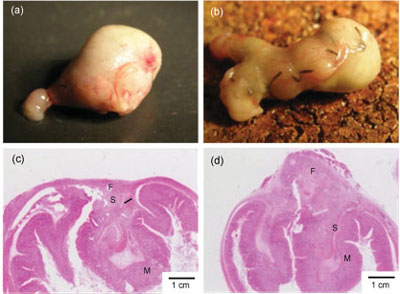
Macroscopic and microscopic observations of the stomach seven days after treatments. Sealing with the PLLA nanosheet (a,c). Conventional suture/ligation (b,d). Letters F, M, and S show fibroblasts, mucosa, and submucosa, respectively. Sealing surgical incisions with this nanosheet instead of performing the traditional suture and ligation procedures is more than just a godsend for Hollywood's plastic surgeons. In cases where internal organs or other tissue has been severely damaged, repair by suture and ligation may become technically difficult and unreliable. Also, internal scarring can lead to sometimes dangerous adhesions, with areas of tissue that should remain separate become joined by scar tissue.Researchers have already been working on novel glue-type (see for instance: Gel-based glue fastens snails to wet surfaces, model for surgical adhesive and sheet-type biomaterials for wound dressing. "Ideally" explains Takeoka, "desirable properties of a novel wound dressing material should incorporate the advantages of both types, that is, not only sufficient adhesive strength to cover the wound site as with a sheet-type structure, but also compatibility with the site as with a glue-type structure."The nanosheet developed by the Japanese team fits that bill – it has very interesting features such as high adhesiveness, high flexibility, and high transparency at the same time. PLLA and other polyesters have been clinically applied in drug delivery and as degradable stitches before, but not as nano-thin sheets. Interestingly, the mechanical properties of the nanosheets are very different from the conventional thin film of the same components.

t
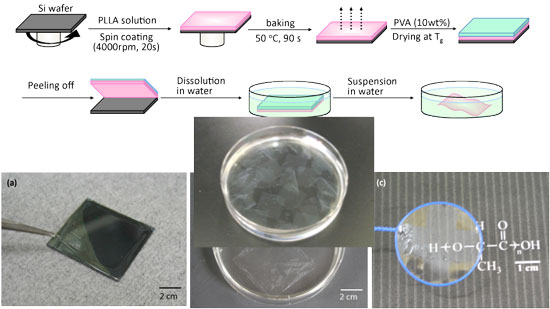
Preparation of PLLA nanosheets and appearancePreparation of PLLA nanosheets and appearance. (Image: Dr. Shinji Takeoka, Waseda University)

Takeoka explains that his and his team's scientific backgrounds are bio-related macromolecular chemistry and molecular assembling science and engineering." We have studied platelet substitutes, which are biodegradable nanoparticles such as phospholipid vesicles and polymerized albumin particles carrying platelet membrane proteins and peptides for ten years" he says. "We noticed that the nanoparticles specifically accumulated at sites of vascular injury and had hemostatic ability. Moreover, in order to enhance their hemostatic abilities, we proposed the idea of sheet-shaped carriers having a larger contact area for a targeting site than spherical nanoparticles." To demonstrate the suitability of their nanosheets as a novel wound dressing material that lacks adhesive reagents, the researchers repaired incisions on mouse stomachs with them instead of sutures. They found that the PLLA nanosheet has an excellent sealing efficacy and the healed wound showed neither scar nor tissue adhesion. Although it will be several years before this material is developed enough to enter clinical trials, Takeoka expects that the nanosheet will be applied not only in the field of surgery as a wound dressing instead of conventional suturing operation but also in the field of plastic surgery, endoscopic surgery, regeneration medicine, and external use (skin etc.). He also sees applications in the fields of material science, material engineering, and surface science.

Friday, July 31, 2009

Cryolife Q2 '09 - Edited

Product revenues which consists primarily of BioGlue and HemoStase increased 5% in the second quarter of '09 compared to the second quarter of '08 and increased 6% in the first half of '09 compared to the first half of '08. We had a very difficult prior year quarterly comp for BioGlue as the second quarter of last year was by far our best quarter during 2008.

BioGlue revenues were 12.4 million and 24.1 million for the second quarter in the first six months of '09 compared to 13 million and 24.9 million for the corresponding periods in '08. BioGlue revenues in the second quarter of '09 did improve over the first quarter of '09 with an increase of 5%.

Excluding the effects of changes in foreign currency exchange rates year-over-year which reduced BioGlue revenues by 331,000 and 639,000 in the second quarter and first six months of '09, BioGlue revenues would have been 12.7 million and 24.8 million.

HemoStase revenues for the second quarter and first six months of '09 were 1.5 million and 2.6 million. HemoStase was added to our product portfolio in the second quarter of '08.

Tissue processing and product gross margins were 63 and 64% for the second quarter and first six months of '09 compared to 66 and 65% for the corresponding periods in '08. We expected to see this decrease in gross margins as HemoStase sales which carry a lower gross margin than our recent aggregate gross margins continue to grow. And with some pricing pressure that we've seen as a result of the economy and it's effect on hospital purchasing patterns.

Tissue processing and product gross margins were 63 and 64% for the second quarter and first six months of '09 compared to 66 and 65% for the corresponding periods in '08. We expected to see this decrease in gross margins as HemoStase sales which carry a lower gross margin than our recent aggregate gross margins continue to grow. And with some pricing pressure that we've seen as a result of the economy and it's effect on hospital purchasing patterns.

Once we receive final IDE approval, our clinical study will evaluate BioFoam as an adjunct on cessation of bleeding by ligature or conventional methods is ineffective or impractical on liver parenchyma. This is a two part investigation including a feasibility phase followed by a pivotal phase. Both phases will be prospective, multi-center, randomized and controlled.

The feasibility phase of the investigation will be conducted at a maximum of two investigational sites. And we'll enroll 20 eligible subjects. The pivotal investigation will include a total of 164 eligible subjects, 82 subjects and each treatment group enrolled across a maximum of 10 investigational sites.

We believe that we can obtain commercial approval in approximately two to three years. We think the annual worldwide market opportunity for a product like BioFoam used for the sealing of abdominal parenchymal tissues is over a 100 million. We continue to evaluate other potential uses for BioFoam including its clinical utility in the treatment of traumatic injuries and in cardiovascular surgery.


Thursday, July 30, 2009

Hemostat IFU and Brochure Downloads

For your information currently including J&J, Baxter, Vascular Solutions, Orthovita, SMI, Cryolife, further materials are welcomed along with updates (please send to hemostatguy@gmail.com) , all materials provided are and sent must be freely available online and from a verifiable email address. You may download or share by clicking on the thumbnails below..........Please Do view the sidebar Disclaimer also displayed below this post as all information is subject to change and is not for clinical use, always review the company/product information directly. No liability is accepted by this Author.

Disclaimer: All data and information provided on this site is for informational purposes only. I make no representations as to accuracy, completeness, currentness, suitability, or validity of any information on this site and will not be liable for any errors, omissions, or delays in this information or any losses, injuries, or damages arising from its display or use. All information is provided on an as-is basis.


Wednesday, July 29, 2009

Orthovita schedule Q2 date

Orthovita, Inc, a leading orthobiologics and biosurgery company, will hold a conference call on Thursday, August 6, 2009, at 8:30 a.m. Eastern Time, to review and discuss its financial results for the second quarter 2009 and update full year guidance. Antony Koblish, President and Chief Executive Officer, and Nancy C. Broadbent, Senior Vice President and Chief Financial Officer of Orthovita, will host the call.

The telephone number to join the conference call from within the U.S. is (888) 815-2919, and from outside the U.S. is (706) 643-3675. The conference identification number is 18137278. Participants should dial in ten minutes prior to the scheduled start time for the conference call.

A replay of the conference call will be available for two weeks beginning August 6, 2009, at 11:30 a.m. Eastern Time, and ending August 20, 2009, at 11:59 p.m. Eastern Time. You may listen to the replay by dialing within the U.S. (800) 642-1687 or by dialing from outside the U.S. (706) 645-9291. The replay identification number is 18137278.

Friday, July 24, 2009

Vascular Solutions - Q2

Net revenue from hemostat products (primarily consisting of the D-Stat(r) Dry, D-Stat Flowable and D-Stat Radial products) was $6.4 million during the second quarter, an increase of 6% over the second quarter of 2008. "The two principal reasons for our sales growth in hemostat products were the exit of a competitor's patch product from the market and the growing sales of our new 'Wrap' version of the D-Stat Dry," commented CEO Mr. Root.

Blood Transfusion and Blood Conservation in Cardiac Surgery - Clinical Paper

Another Reader supplied article Perioperative Blood Transfusion and Blood Conservation in Cardiac Surgery - Society of Thoracic Surgeons and Society of Cardiovascular Anesthesiologists.
You may view or download by clicking on the thumbnail.

Thursday, July 23, 2009

Thrombin - Presentation

Courtesy of a reader....
You may view or download by clicking on the thumbnail.

Monday, July 20, 2009

Clinical Papers


Dear Reader,
I am inviting submissions for inclusion under the new label of "Clinical Papers" as per the paper below. If you have an article you feel would be useful or of interest please feel free to submit to me directly at hemostatguy@gmail.com
EMS, Surgical, Topical, Sealant, Glue and intravenous articles are all welcomed!

Clinical Benefits and Risks of Topical Hemostats: A Review

You may view or download by clicking on the thumbnail.

Thursday, July 16, 2009

ADVTX Announces New Treatment for Bleeding After Nuclear Exposure

Fibrinoplate-S a viable alternative to platelet transfusion for survivors of near-lethal doses of radiation

ANAHEIM, Calif.--(BUSINESS WIRE)--Advanced Therapeutics & Co. (ADVTX) announced today that Fibrinoplate-S™ has shown efficacy in reducing the bleeding in animals exposed to extreme doses of radiation. Survivors of a nuclear event or a dirty bomb explosion will have similar damage from the ionizing radiation of such bombs.

“Acute radiation can severely damage the bone marrow,” Richard Yen, Ph.D., M.D., CEO of ADVTX explained. “While existing medications can boost the production of red cells and white cells from the recovering bone marrow, there is no effective treatment for low concentrations of platelets except through platelet transfusion. Donor platelets, however, may not be available or adequately screened for pathogens during times of distress.”

Viable Alternative to Platelet Transfusion

ADVTX Fibrinoplate-S, a suspension formulation of human albumin spheres coated with a coagulation factor (fibrinogen), mimics the action of activated platelets. Random clots have not been observed even as bleeding improves after the administration of Fibrinoplate-S.

In preclinical trials, Fibrinoplate-S reduced bleeding within 2 hours after a bolus intravenous administration in test subjects with less than 1% of the normal platelet count. The beneficial effects last at least 24 hours. There is no need to match the recipients’ blood types. Fibrinoplate-S can be given to a large number of patients quickly.

Availability

ADVTX can scale up its production of Fibrinoplate-S quickly. Government agencies may include Fibrinoplate-S in their emergency response plans by submitting a “pre-EUA” (pre-Emergency Use Approval) to the US FDA. Licensing outside the United States is available. Visit www.ADVTX.com.