Wednesday, May 12, 2010

Nanoscale features patterned on surfaces of polymer biomaterials can prevent blood clots

(Nanowerk News) Implanting artificial materials or devices in patients can cause adverse reactions when contacting natural tissue and blood. In blood-related defense mechanisms, plasma proteins quickly adsorb on the biomaterial surfaces and trigger a series of biochemical events that lead to platelet adhesion and aggregation into blood clots. The clotting can hinder the performance of an artificial device and can be life-threatening in some instances.
Now, Isabel Rodriguez from the Institute of Materials Research and Engineering of A*STAR, Singapore, and co-workers have discovered that adding miniature topographical features to polymer surfaces can reduce blood coagulation and improve the ‘hemocompatibility’, or blood compatibility, of biomaterials ("The effect of topography of polymer surfaces on platelet adhesion").
Using chemical modifications, many researchers have tried to coat or graft a secondary material to the surface of biomaterials to enhance their biocompatibility. Attempts to date, however, have met with limited success.
In many circumstances, secondary materials can leach out from the modified surfaces, which may have toxic effects, according to Rodriguez. “Hence, a biocompatible surface without additional chemical modifications is most desirable,” she says.

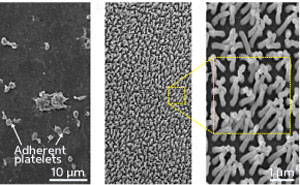
Scanning electron micrograph showing that platelets adhere more to a planar surface (far left) than a nanostructured polymer surfaceFig. 1: Scanning electron micrograph showing that platelets adhere more to a planar surface (far left) than a nanostructured polymer surface (center, right).
To achieve this goal, Rodriguez and her team prepared various nano- and micro-structured surfaces from the biocompatible polymer poly(lactic-co-glycolic acid) (PLGA). They used alumina and silica templates prepared using nano- and micro-fabrication techniques to create nano- and micrometer-sized cavities. They then deposited PLGA solutions into these templates and cured them under vacuum to produce the structured polymer films.
Next, the researchers incubated the surface-structured PLGA films with human fibrinogen—blood protein that mediates platelet adhesion and activation—and then with platelet-rich plasma. Finally, by quantifying fibrinogen, platelet adhesion and platelet activation, they assessed the ability of the films to promote blood clotting. Significantly fewer platelets adhered to surfaces covered with dense, high aspect ratio, nanometer-sized features than to planar surfaces (Fig. 1).From a comparison between a featureless PLGA film and an inert carbon surface, the researchers found that surface chemistry had an important role in the initial adsorption of proteins and platelets. However, appropriated surface features can overcome or complement the effect of chemistry and indeed reduce the tendency of blood clotting on an artificial surface, notes Rodriguez.“Surfaces with [a] high level of hemocompatibility will have important applications in surgical tools such as catheters and implantable medical devices like heart valves, stents or vascular grafts,” says Rodriguez. The team is currently planning to perform in vitro tests using whole blood samples, instead of just plasma, to assess clot size formation and clotting rate before moving on to in vivo tests.

Monday, May 10, 2010

Lawyer calls drug vials 'weapons of mass infection'

The drug companies that produced and sold the sedative linked to Southern Nevada's hepatitis C outbreak provided large vials of medication to endoscopy centers despite their risk to public safety, a lawyer charged Friday.

"These drug companies knew that these were weapons of mass infection. They knew what was going on in these endoscopy centers. ... They knew it for years and years and years, and they did nothing to stop it," Robert Eglet told a jury during closing arguments in the first trial stemming from the outbreak.

Eglet represents Henry Chanin, 62, who was infected with hepatitis C during a 2006 colonoscopy at the Desert Shadow Endoscopy Center, one of two clinics linked to Southern Nevada's hepatitis C outbreak.

Chanin, headmaster at The Meadows School, and his wife, Lorraine, are suing Teva Parenteral Medicine and Baxter Healthcare Services, which made and sold the drug propofol, on several product liability claims.

After hearing two weeks of trial testimony, the jury began deliberations late Friday afternoon to decide whether the companies should he held liable for Henry Chanin's infection.

His case was one of nine linked to two Las Vegas endoscopy clinics by health officials, who in 2008 notified 50,000 patients about possible exposure to hepatitis, HIV and other blood-borne diseases because of unsafe injection practices at the clinics. Hundreds of patients have filed lawsuits as a result of the outbreak.

Officials blamed the local outbreak on nurse anesthetists reusing single-dose drug vials between patients after the vials had become contaminated by the nurses reusing syringes on the same patient.

Eglet said the companies knew of the temptation to reuse the large 50 milliliter vials of propofol, which contained four to five times the amount needed for a typical 10-minute colonoscopy.

"They knew they were going to be 'double dipping' on this between patients," he said.

Teva and Baxter should have known about the dangers because propofol was associated with seven previous hepatitis C outbreaks that infected 148 people, he said.

Eglet also pointed to a report Teva wrote to the U.S. Food and Drug Administration in 2000 to get approval to make 10 milliliter vials of propofol. The report acknowledged that some medical workers were reusing the larger vials among patients to avoid throwing away unused anesthetic.

The smaller vials would improve patient safety undergoing endoscopic procedures because there would be less leftover anesthetic to tempt medical workers to reuse the vials, the report stated.

Teva made the 10 milliliter vials until 2007, when it stopped production in part because the smaller vials cost more to make than the larger vials, Teva executive Craig Lea testified at trial.

Based on their knowledge of previous misuse of the larger vials, the drug companies should be held liable because the misuse was "reasonably foreseeable," Eglet said.

The lawsuit originally named the doctor and nurses who performed Henry Chanin's colonoscopy, but their insurance company settled the medical malpractice claim last month, preventing the drug companies from shifting blame.

"They cannot point the finger at somebody who is not here," Eglet said.

The Chanins' suit also claims warning labels on propofol inadequately warned of the dangers of reusing the vials.

Drug company lawyer Mark Tully defended his clients, saying there was nothing defective about the propofol, which worked exactly as it was supposed to during Chanin's colonoscopy.

He said Teva made the 10 milliliter vials until 2007, when they were discontinued because doctors preferred to buy 20 and 50 milliliter vials. It was up to the medical professionals to decide which size was appropriate because the amount of propofol needed varies by procedure length and patient size, he said.

"There are uses for 20s and 50s that are entirely acceptable," Tully said.

He also dismissed the 148 hepatitis C cases Chanins' lawyers connected to propofol, pointing out that all of those infections were blamed on poor techniques for maintaining a sterile environment, such as reusing syringes and improperly cleaning scopes, which were warned against in the drug packaging.

"There are risks with using propofol, and the way to avoid those risks is to use proper aseptic technique and only use the vial on one patient," Tully said, noting that every propofol vial had "single-patient use" written in red letters.

Since being infected with the hepatitis C virus, which makes the liver swell and stops it from working correctly, Henry Chanin has lived with the constant worry of infecting his wife. The couple have stopped doing anything that might spread bodily fluids, from sharing a glass of wine to having sex. He also deals with lingering side effects of fatigue and joint pain two years after undergoing chemotherapy-like treatment for hepatitis C.

Eglet asked the jury to award him $8.5 million in damages to account for economic losses and his suffering. Lorraine Chanin's lawyer, Will Kemp, asked the jury to award her between $1.6 million and $2.3 million.

Eglet also encouraged the jury to levy punitive damages against the drug companies because of their conscious disregard for public safety in the name of profits.

"You can't put them in jail. We can't do other things," Eglet said. "The only thing we can do, quite frankly, is hit them where they take notice ... with money."

Egypt Bars Israeli Doctor from Int'l Conference in Cairo

Egypt has barred an Israeli hematology expert from attending an international conference set to take place this month in Cairo despite the longstanding peace treaty between the two nations.

Dr. Uri Seligsohn, Professor of Hematology at Tel HaShomer's Sheba Medical Center, has been unable to obtain a visa from the Egyptian government in order to attend the conference, scheduled for May 22-25. It was Seligsohn who had supported a decision to approve Cairo as the location for the meeting site, two years ago.

He is chairman of the Education Committee of the International Society on Thrombosis and Haemostasis (ISTH), the organization that is sponsoring its 56th Scientific and Standardization Committee (SSC) meeting, which he intended to attend.

The professor told the Hebrew-language Ma'ariv newspaper over the weekend that at the time, he “thought that there were ties of peace and friendship between Israel and Egypt,” and that “with the help of the conference we would be able to develop the Egyptian medical system – but unfortunately I was wrong.

“Apparently the Egyptians are uncomfortable that a Jew and an Israeli doctor should come to their conferences.

“Since it became known that the Egyptians refuse to approve my entry there has been a tremendous commotion among researchers and doctors around the world,” he said, according to IMRA (Independent Media Review and Analysis), which translated the report. “I know of many researchers who have canceled their attendance at the conference. The management of the organization has announced that this move will have serious ramifications for scientists in Egypt.” (IsraelNationalNews.com)

Friday, May 7, 2010

vCJD Families Protest outside Downing Street, London


The government has recorded 168 deaths due to variant CJD - caught from infected bovine material - but this figure is contested as being inaccurate by the families of victims because many of the families who have lost a loved one to this devastating brain disease say that they were never recorded in the official statistics.

Victims are also recorded as 'sporadic CJD', which was the original and very rare form of CJD that can occur in anybody and is not related to infected cattle.

Some cases, even in people in their teens and twenties, are put down to 'early onset alzheimer's disease'. Those left to nurse their husband's, son's, daughter's and wives through the terminal illness say that this is part of a cover up to protect pharmaceutical industries, who use bovine products widely in medicines and vaccines.

Unsafe Blood Donations

Eighteen UK blood donors later died of vCJD and their blood was used to make vaccines and medicines such as factor 8 which is given to haemophiliacs. Some haemophiliacs have since died of vCJD after being given infected blood. Despite this, the government refuse to screen donated blood. An effective test is available but they will not use it. Why not? Christine Lord, Grahame Bell and other members of the protest think it's maybe because screening people's blood would reveal the true magitude of the problem, which would be a disaster of epic proportions for government, the pharmaceutical and agricultural industries.

UK blood bags have warning labels on them due to being possibly contaminated with vCJD and they are not allowed for donation in any other country in the world apart from the UK.

Individual Fibrin Fibers Distribute Strain Across A Network

A new study shows that when it comes to networks of protein fibers, individual fibers play a substantial role in effectively strengthening an entire network of fibers. The research, published by Cell Press in the April 20th issue of the Biophysical Journal,describes a mechanism that explains how individual fibrin fibers subjected to significant strain can respond by stiffening to resist stretch and helping to equitably distribute the strain load across the network.

Fibrin is a fibrous protein that assembles into a remarkably strong mesh-like network and forms the structural framework of a blood clot. Failure of a clot can have fatal consequences. For example, if a portion of the clot breaks away and is carried downstream by the flowing blood, it can cause a stroke or heart attack. Although previous research has characterized the mechanical properties and behavior of fibrin networks on a macroscopic level, much less is known about the behavior of individual fibrin fibers and the distribution of strain from one fiber to the next.

"We know that network strength is determined in part by the maximum strain individual fibers can withstand, so it is of particular interest to determine how the high strain and failure characteristics of single fibrin fibers affect the overall strength of the network," says senior study author Dr. Michael R. Falvo from the Department of Physics and Astronomy at the University of North Carolina at Chapel Hill. "Further, determining how strain is shared among the constituent fiber segments in a network under imposed stress is crucial to understanding failure modes of networks and their strength."

Dr. Falvo and colleagues used a combined fluorescence/atomic force microscope nanomanipulation system to stretch two dimensional fibrin networks to the point of failure while recording the strain of individual fibers. "Specifically, we observed that as fibers were stretched, they became stiffer than the surrounding fibers at lower strains; this allowed the more strained, stiffer fibers, to distribute the strain load to the less strained fibers and reduce strain concentrations," explains Dr. Falvo. "So in effect, strain stiffening in the individual fibers acts to distribute strain equitably throughout the network and thereby strengthen it."

The strain concentration reduction effect described in this study may be part of an important physiological mechanism to strengthen blood clots under high shear conditions in the blood stream. The authors note that along with this physiological insight, their findings bring about a better understanding of this remarkable strengthening mechanism and may help to guide new design strategies for engineered materials

Thursday, May 6, 2010

ZymoGenetics Webcast

SEATTLE, May 05, 2010 (BUSINESS WIRE) -- ZymoGenetics, Inc. announced today that Douglas E. Williams, Ph.D., Chief Executive Officer of ZymoGenetics, will present at the Bank of America Merrill Lynch Health Care Conference in New York City on Wednesday, May 12, 2010 at 10:40 a.m. Eastern Time.

A live webcast of the presentation can be accessed by going to: www.zymogenetics.com. The webcast will be archived for 30 days.

King Q1 - Thrombin sales continue slide

Thrombin-JMI net sales totaled $37 million during the first quarter of 2010 compared to $47 million in the first quarter of last year. Net sales of Avinza totaled $23 million compared to $39 million in the first quarter of 2009.

Marc Goodman – UBS....And then can you talk about THROMBIN a little bit. It just – our understanding is that pricing had stabilized a little bit and share had stabilized but it just seems like this product just keeps going down, I mean you can give us the flavor of how should we think about it. Thanks.

Joe Squicciarino.......THROMBIN, yes so yes we had seen price settle down in the marketplace. The comparison that we’re now making now of course is first quarter of this year versus the first quarter of last year, where price is still a factor. The decline versus last year’s first quarter, once again is split evenly between price and volume, but fortunately we’ve seen price stabilize and hopefully it’ll stay that way.

Source:Seekingalpha

HemCon to ask court to reverse $29.4M patent award

An Oregon company plans to challenge a $29.4 million jury award to a Massachusetts company for patent infringement over a product derived from shrimp shells or algae that can be used to control bleeding. HemCon Medical Technologies Inc. of Portland says it makes a material called chitosan from shrimp shells while Marine Polymer Technologies in Danvers, Mass., makes it from algae. The chitosan is used in bandages to help control bleeding and infection from trauma or surgery and to treat battlefield wounds for the military. Last week, a U.S. District Court jury in Concord, N.H., ruled in favor of Marine Polymer in a patent infringement lawsuit it filed against Hemcon four years ago. Sergio Finkielsztein, president and CEO of Marine Polymer, praised the verdict and said the company will seek a permanent injunction against HemCon. "Our company was built on innovation, and new technologies we have developed since the early 90s and continue to develop to this day," Finkielszstein said. But John Morgan, president and CEO of HemCon, said the verdict would allow the patent to cover shrimp-based chitosan compounds that were publicly disclosed by others well before the Marine Polymer patent application was filed. "We believe the jury's decision is wrong and will ask the court to review and reverse it," Morgan said Wednesday. He also said the U.S. Patent Office granted a HemCon request for re-examination of the patent last November and the agency made an initial determination last month to reject Marine Polymer's claims. Morgan said the Patent Office indicated its willingness to allow the claims of the patent if Marine Polymer would limit them to algae. "There were broad claims in the patent that looked at all forms of materials," Morgan said. "But clearly the process and material employed by Marine Polymer is not what we used."

Wednesday, May 5, 2010

Zymogenetics Q1 2010 - "Soft" Hemostat Market in January

On the RECOTHROM front net sales for the quarter was $9 million. This is doubling of Q1 sales for 2009. January in particular was a very weak month across the hemostat segment and RECOTHROM was no exception. That said, for the quarter actual hospital demand that it's units moving from the wholesaler inventory to hospital end user increased by 14% compared to the fourth quarter of 2009.

RECOTHROM market share in dollars continued to increase in Q1 to approximately 19% versus 17% in the prior quarter. Jim will discuss the factors that influence our reported net sales for the March 31st quarter, but demand in market share continued to grow and based on momentum we see in the market place, we are comfortable with our full year guidance of $48 million to $54 million of net sales............

Net sales of RECOTHROM were $9 million for the quarter, doubling from $4.5 million a year ago. Net sales were approximately the same as the fourth quarter of 2009 even though we had positive trends in units sold to hospitals and market share as Doug described earlier.

There are two primary reasons for this, both of which were related to differences between the timing of hospital purchases and when we record revenue based on sales to wholesalers. First, decreases in wholesaler inventory levels had a significant impact. We estimated there were about 2.4 weeks of sales in the channel at March 31st, compared to about 3.2 weeks at the beginning of the quarter.

Second, the way that the weeks fell in the calendar had a significant impact, in that there was about one week fewer sales included in the three months ended March 31st compared to the three months ended December 31st. Together these two factors caused our reported net sales to be lower than one would expect based on underlying hospital sales trends.............

Brian Abrahams - Oppenheimer and Company

Great. Can you remind us how was [RECOTHROM] reimbursed and what impact the healthcare reforms would you expect?

Stephen Zaruby

Well, as three reimbursement was captured in the cost of any surgery we don’t see there will be any impact on the reform side at all in terms of our pricing and how we capture. So my guess, we are fortunate in that one of the few maybe who are not affected by that..........

David Miller - Biotech Stock Research

Now switching to RECOTHROM for a moment, can we expect the kind of continued slow grind we have seen for RECOTHROM sales on a quarter-over-quarter basis? Going forward, is there some kind of invents that we can look forward to that might provide an inflection or you would be replacing more of the JMI sales out there?

Stephen Zaruby

This is Stephen Zaruby. I think as Doug said we are encouraged by the momentum that we have seen, but moving forward obviously we are very active in the marketplace at all kinds and different touch points and levels be it through our sales force or national accounts people dealing with GPOs and so on and so forth and as Doug said we remain confident in our annual guidance and so it depends how you might forecast or sort of allocate our sales quarter-by-quarter, but we expect to see continued growth and the growth certainly comes largely or entirely at the expense of Thrombin-JMI........

Paul Latta - McAdams Wright Ragen

One another question on the RECOTHROM, you mentioned that the hemostat market was a little soft in January, any thought as to why?

Doug Williams

It's hard to say. I think it was sort of an observation we made looking at the totality of the markets. If you recall Paul we saw similar situation with our fourth quarter to first quarter situation last year, but I don’t know how much of it is sort of seasonally related, but I think beyond the metrics that Jim sketched out in terms of one less week and drawing down the wholesaler inventory levels. Those are really the sort of firm facts we can throw out and beyond that I think we just beat speculation as to what was happening in the market there, but quite clearly January for everyone in the hemostat area was a soft month.

Paul Latta - McAdams Wright Ragen

Is their [year-end] budget plus possibility too?

Doug Williams

Again it's hard to say. I think you could relate it to everything from bad weather on the East Coast to general economic conditions, but I think fundamentally we don't really have a clear-cut answer for you as to why January was soft.

Source: Seekingalpha

Tuesday, May 4, 2010

Orthovita Q1 2010 - Edited

Our biosurgery sales increased 12% during the first quarter of 2010, compared to the first quarter of 2009. Biosurgery offers an important strategic entry to hospitals where our Hemostats product have many application and new sales representatives benefit particularly from this product line as they seek to gain access to new accounts......

Graham Tenneco

What is the direction or do you think drift going to be or trends based on the Obama's healthcare plan and what might meaningful procedures and where an ASP basically?

Tony Koblish

We can't know all of that what's going to happen. However, I think the concept of evidence-based medicine and clinical data and clinical value proposition to the patients; I believe is going to be more and more important as we go forward. I think that we are exceptionally well positioned across all of our product platforms for that day, not just with Cortoss, which happens to have superb therapeutic benefit, value proposition to the patient, subsequent fracture benefit to the patient also reduced healthcare expenditure and re-hospitalization as shown in our clinical data, but we have an excellent proposition around the Vitoss business relative to more expensive therapies in bone grafting and our Vitagel business is also plays to demonstrate some effected clinical data around knee replacements etcetera. So, I think we are very well positioned in terms of comparative effectiveness, clinical data value proposition that one trend that’s not going to go away and I think that’s going to just be the price to play going forward. We are not going to get there all at once, but it’s going to happen and so I think cost effective, clinical value proposition we are very well situated for that eventuality, which is I think going to be the major fallout long-term.

Source: Seekingalpha